What these small black beetles mean for the health of Malcolm Knapp Research Forest
And Quinlan Wu’s journey from insect hobbyist to researcher

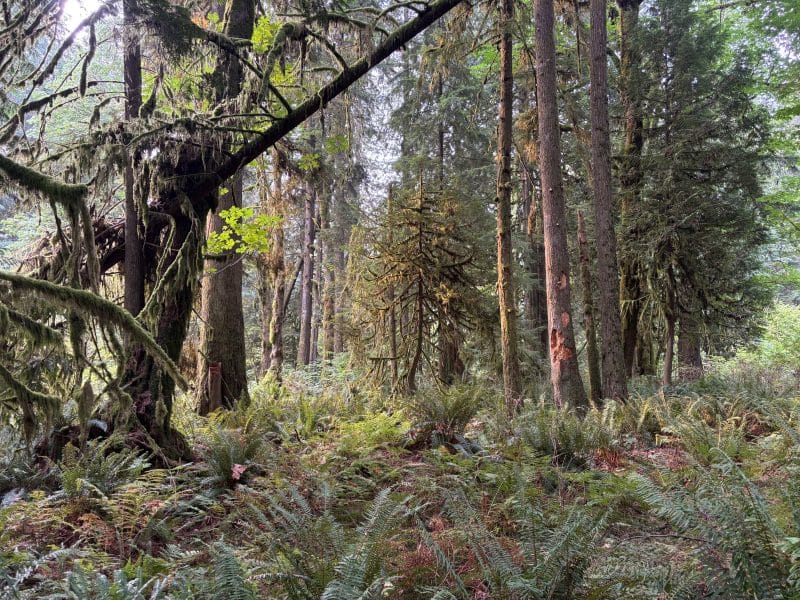
In the Malcolm Knapp Research Forest, Quinlan Wu made a discovery while using a net to scoop up water and debris from forest ponds.
The University of British Columbia student and diving beetle researcher joined the Entomological Society of British Columbia’s (ESBC) BioBlitz event at the beginning of the month, participating in a two day insect count to survey some of the area’s biodiversity. In doing so, he found a few interesting beetle species that haven’t been documented within Metro Vancouver for decades, if ever.
There was Lara avara, a riffle beetle rarely collected in the region, and Zaitzevia Parvula, another riffle beetle species he believes has never been documented in this neck of the woods.
Riffle beetles, a family of aquatic beetles, are known as biological indicators, said Wu.
“They almost exclusively prefer clean, fresh, unpolluted streams,” he said. “Finding riffle beetles tells you a lot about the quality of stream water and water quality in those areas.”
Finding these riffle beetles in Malcolm Knapp shows that there’s little pollution or runoff in those streams, he said.
Diving beetles
But Wu is a diving beetle (another water beetle family) researcher, and he found a couple at the BioBlitz that also piqued his interest — including a hydroporus fortis, which he said hasn’t been found in B.C. since the ‘70s.

This is an insect he’s been keen to find since late 2023 or early 2024. Wu said he’s certain he kept one as a pet (a long time hobby of his, before he started his official research), but didn’t have a microscope to know for certain.
“And I haven’t been able to find it since, until this BioBlitz.”
There could be a number of reasons why they haven’t been documented in decades, Wu explained. They live in forest pools, which tend to be less stable than rivers or streams — especially in urban areas.
“There’s so much development, these ponds often get paved over or completely filled up, or new ponds are made oftentimes as well,” he said, meaning it’s hard to predict where or when beetles will colonize specific habitats.
“And sometimes, when not enough of these habitats exist in an area, these populations can go extinct.”
Wu’s journey into beetle research
Wu is currently an anthropology major at UBC. But throughout his childhood, he was an avid bug-lover — his first pet was a mantis.
In 2023, this passion for bugs was reignited while on a family vacation in the Sunshine Coast. He had decided to venture out and look for a night stalking tiger beetle, found one, and kept it as a pet.
“That was a very pivotal moment for me,” he said. “I forgot how much I enjoyed doing that kind of stuff.”
That fall, he took an intro entomology (the study of insects) class, and eventually decided to minor in that field.
One of his professors encouraged him to apply for an ESBC research grant to study dytiscus, a genus of diving beetles, in Metro Vancouver.

While there’s been research on the adults of this genus, the larvae is less studied, Wu said.
“Most of them out west here just haven’t been touched. They haven’t been described. There’s no way of — at least no published way — of differentiating the different species,” he said. “And so that’s what my project sets out to do. It’s describing those species of larvae, and figuring out the ways to differentiate them.”
Wu first got the idea while at Pitt Addington Marsh in summer 2024, when he came across a larva, “that looked so strange and interesting” but he couldn’t find anything published on what it was.
He learned that to determine what kind of species it was, you keep it and rear it to adulthood, since there are descriptors of what many look like as adults.
“It really interested me that the way that this kind of science is done. In order to describe things like larvae it is pretty much just having to keep them as a pet for a little bit.”