YPK defends operations after concerns raised over leaded aviation fuel
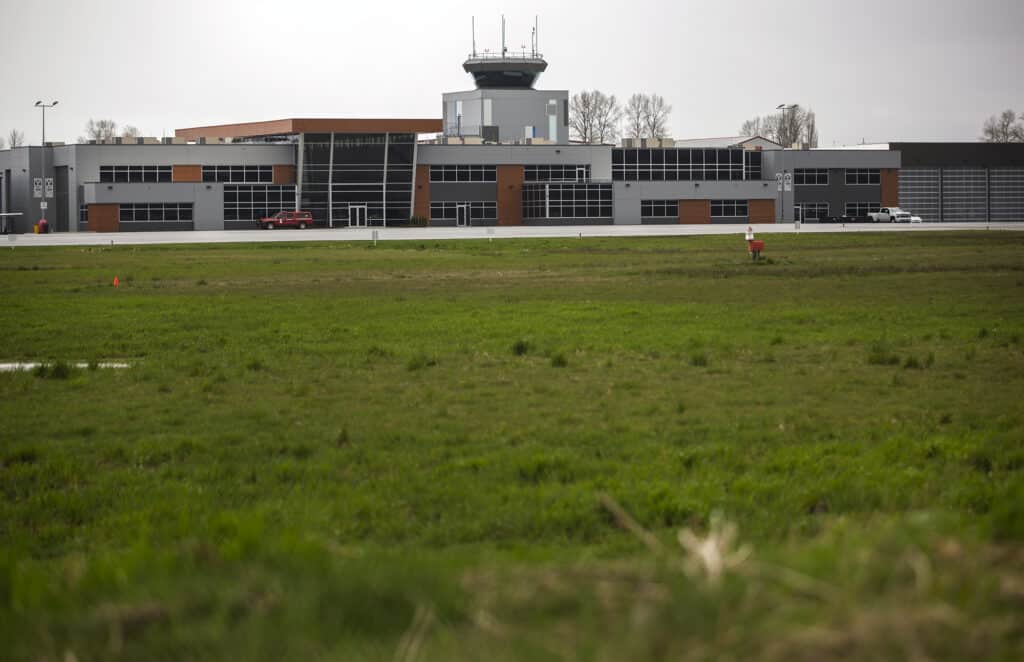
The Pitt Meadows Regional Airport (YPK) is pushing back against concerns raised in a recent opinion article that warned of potential health risks from lead emissions associated with growing flight activity at the airport.
In a statement released on June 15, the airport said it supports the federal government’s efforts to reduce aviation emissions and transition toward cleaner technologies, emphasizing that aviation fuel standards and regulations fall under federal jurisdiction.
The response comes after a June 10 opinion piece in the Vancouver Sun by Paul Kershaw, a policy professor of UBC’s school of population & public health, and a longtime Pitt Meadows resident.
Kershaw argued that increasing flight activity at the airport could increase lead exposure risks for nearby residents, particularly children, because many small piston-engine aircraft continue to use leaded aviation gasoline.
He noted that YPK is home to 10 flight schools and cited Statistics Canada figures showing aircraft movements reached 208,551 in 2025, roughly double the level recorded a decade earlier. He called for a phase-out of leaded aviation fuel and urged local governments to support cleaner aviation technologies.
In its response, the airport said it “fully supports and endorses Canada’s Aviation Climate Action Plan,” a federal strategy aimed at achieving net-zero greenhouse gas emissions from aviation by 2050.
The airport highlighted several pathways identified in the national plan, including the development of electric, hybrid and hydrogen-powered aircraft, improvements to air traffic management and ground operations, and the wider adoption of sustainable aviation fuels.
Airport officials stressed that the use of leaded aviation fuel is regulated by Transport Canada, not local airports.
“Leaded aviation fuel is currently approved, sold, and consumed by thousands of aircraft at hundreds of airports across Canada,” the airport said.
According to the statement, leaded AVGAS 100LL remains the standard fuel for many piston-engine aircraft and is available at airports throughout the Lower Mainland, including Boundary Bay, Abbotsford, Langley and Pitt Meadows.
The airport said Transport Canada is working with other federal agencies and the U.S. Federal Aviation Administration to approve commercially developed unleaded alternatives for use in Canada, but no formal deadline has been established for eliminating leaded aviation fuel.
Airport officials said the transition is complicated by aircraft certification requirements, engine compatibility issues, fuel infrastructure limitations and the need for a replacement fuel that can be safely used across Canada’s piston-engine fleet.
While noting that aviation fuel regulations are outside its authority, the airport said it supports the eventual adoption of unleaded fuel, electric training aircraft and other emerging technologies.
“The airport fully supports a forward-looking vision for Pitt Meadows Regional Airport which includes cleaner aviation technologies, unleaded fuel, electric training aircraft, sustainable aviation fuels, and the innovation produced by high-tech industries that will power the future of flight,” the statement said.
The airport also announced plans to conduct a carbon emissions study in 2026 to establish a baseline of emissions generated by activities under its operational control.
Officials said the study will help identify practical emission-reduction measures that can be implemented over time, subject to safety requirements, regulatory approvals and available resources.
The airport said it will continue focusing on emission-reduction initiatives that fall within its authority while working alongside federal agencies and industry partners as Canada moves toward its long-term aviation decarbonization goals.
Pitt Meadows Regional Airport is jointly owned by the cities of Pitt Meadows and Maple Ridge. The facility is one of the busiest airports in Canada for general aviation and flight training activity.