Landslide concerns linger as Maple Ridge gives developer final chance to prove safety
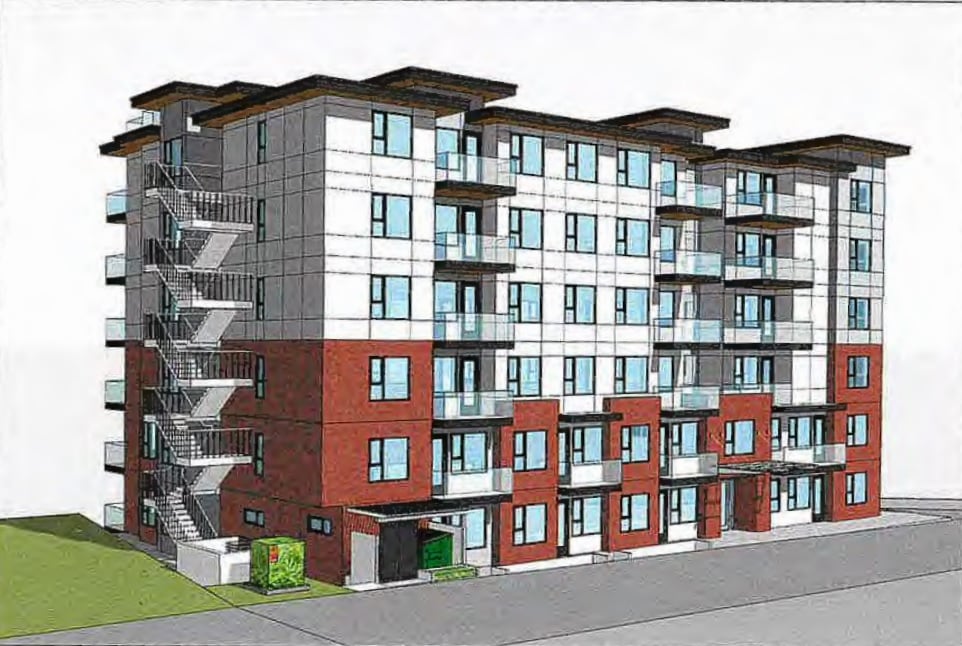
Maple Ridge council is giving a development in a landslide-prone area one final chance to prove it can be built safely, but several councillors had lingering doubts given the history of the application.
The hour-long discussion on April 28 was framed by competing expert opinion between municipal reviewers and Namdhari Construction’s engineers, before a 4-2 vote was cast allowing the developer a a 90-day deadline to meet the city’s requirements.
Mayor Dan Ruimy warned the developer of the six-storey, 44-unit apartment building at 22190 Cliff Ave. not to take council’s demands lightly.
“If this is just going to go back and forth ‘no you’re wrong, no you’re wrong,’ we’re wasting everybody’s time,” he said. “You have to find a way to convince our people that this is a good, safe project, because if they’re not convinced, there’s no way we’re going to be convinced.”
The project sits on a vacant 1,920-square-metre lot perched along the edge of the Fraser River escarpment, where the remnants of the historic Haney Slide – a massive 1880 landslide – extend into the property itself.
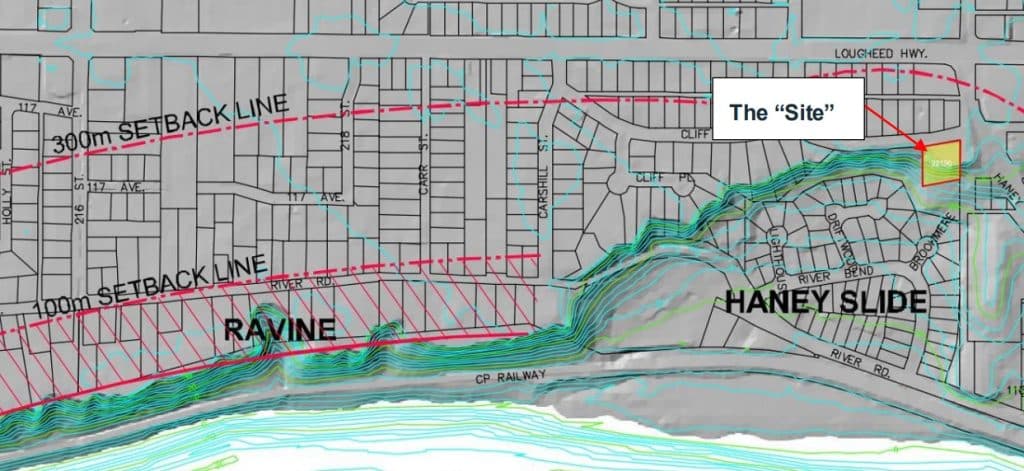
That geological reality dominated the discussion.
Staff, who initially recommended rejecting the project’s natural features development permit, warned council the issue isn’t simply whether the building can be engineered to stand on the site – but whether it can withstand the kind of large-scale slope failure that has shaped the area for more than a century.
Deputy planning director Hasib Nadvi told council the escarpment has been studied for decades by the city, province and researchers, with evidence showing the potential for future movement remains.
“These slides are in the millions of cubic metres,” he said, putting their scale into context by comparing them to thousands of dump truck loads of soil.
City policy requires developers in hazard areas to clearly demonstrate – through detailed technical evidence – that risks to life and safety have been fully identified and mitigated.
But after more than 12 rounds of staff comments and two independent expert reviews, officials say that hasn’t happened here.
A central divide emerged during the meeting over what exactly needs to be proven.
The applicant’s engineers focused on what they described as “local” stability – ensuring the building itself and the immediate slope can be stabilized through design measures like deep foundations and anchoring systems.
But staff and the city’s independent reviewers said that’s not enough.
Their concern is “global” stability – whether the development could withstand a much larger landslide originating beyond the property, including a repeat or partial reactivation of the Haney Slide.
“The report does not explicitly state whether the property and the mitigation measures… speak to addressing a major landslide,” Nadvi said. “That’s the crux of the issue here.”
The city’s February refusal letter pointed to similar gaps, including the absence of analysis on landslide frequency, magnitude, and potential runout – all key requirements under provincial professional guidelines.
Independent reviewers also found the applicant’s reports focused too narrowly on site-specific conditions, without adequately addressing broader escarpment hazards.
James Stiver, director of planning and building, added the city was having challenges with communication with the developer, and they had to make a decision.
“There have been repeated requests for information that was just not provided, confirmation not provided,” he said. “There was sufficient time spent and money spent by the city to deal with this, and it was not moving.”
The developer’s engineer pushed back, arguing the project meets engineering standards and that concerns raised by the city largely relate to broader regional stability and not the building itself.
They said the proposed design would actually improve slope conditions in some areas by removing soil weight and anchoring the structure into the ground.
Staff was also questioned as to why this development is being scrutinized so heavily in an area where homes already exist.
But council members appeared unconvinced that the risk had been fully answered – particularly when it comes to worst-case scenarios.
“We know that this is not a very stable area. It has never been,” Mayor Dan Ruimy said. “When you’re talking about putting 44 units in an area that historically has been unstable, we need our assurances.”
Other councillors echoed that tension, with some indicating they were not comfortable approving the project.
Couns. Jenny Tan and Korleen Carreras both voted against giving the developer more time, stating that enough staff time has been spent on the project which has stalled continuously over the years.
The application itself has a long and winding history, dating back to an earlier version filed in 2018 that was later closed due to inactivity before being resubmitted in 2023.
“There are a large number of deficiencies, it goes on for pages and pages (in the review)” Tan said. “It strikes me that we have been working very hard with 12 rounds of feedback, and I haven’t seen yet an indication of why we continue to spend city resources with staff spending their time on this when we have a city to build”
Other councillors, however, thought the applicant should have a final opportunity to address what staff concerns.
Ruimy pointed to an alternate path forward to find “common ground.”
Rather than uphold the refusal outright, council opted to give the developer up to three months to submit revised technical work addressing the outstanding concerns, particularly around large-scale landslide risk and long-term safety.
The application itself has a long and winding history, dating back to an earlier version filed in 2018 that was later closed due to inactivity before being resubmitted in 2023.
If the applicant can satisfy the city’s requirements within the three-month window, the project could move forward.