Infected and invasive trees plaguing two Pitt Meadows parks
Dozens of trees are coming down in Hoffman and Shoreline parks — for two different reasons

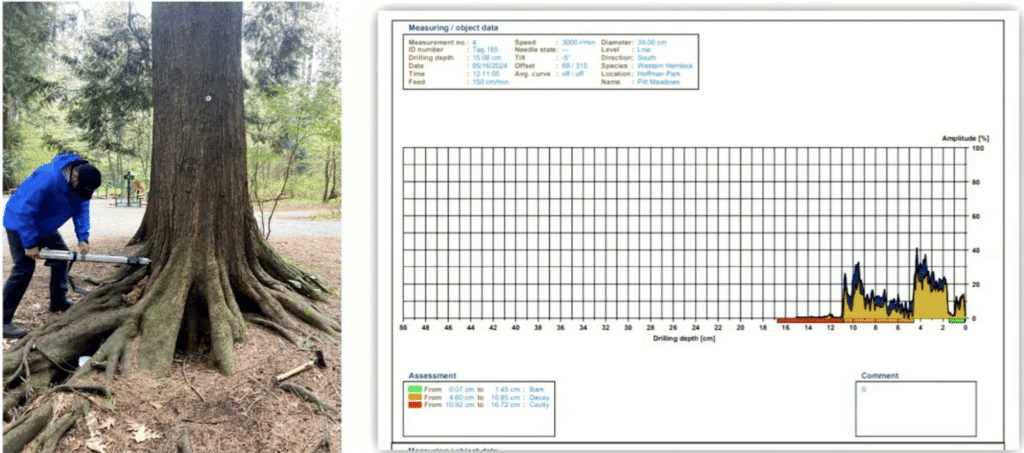
A man in a blue rain jacket holds a drill and walks up to the tree, a western hemlock standing tall in the middle of Hoffman Park.
It looks like any ordinary tree in the park. Its bright, brown bark is securely intact. Its gangly roots, located next to a series of outdoor adult exercise machines, resemble the fingers of a witch — long, narrow and spiraling off in many different directions into the dirt. Its leaves still grow in abundance.
The man injects the drill into the base of the tree. The needle breaks through a layer of bark and another four centimetres of wood, before revealing the disease that is also impacting many other trees in the park.
“From two centimetres to four centimetres it was sound wood,” said Olivia Huppee, the city’s parks supervisor and arborist at a council meeting on June 28. “From four to 10 centimetres it was decay, and from 10 centimeters to 17 there was a cavity. Meaning the centre of the tree was hollow.”
A small group of trees in Hoffman Park have been showing signs of the fungus — thinning and damaged branches — since the winter of 2023, according to a recent report to council.
But not all symptoms are obvious to the naked eye, which led the city to recently hire specialists to test nearly 200 trees for Phaeolus schweinitzii, also known as velvet-top fungus, an incurable fungus that attacks the lower half of a tree and can spread to other trees through the wind or root-to-root infection.
“What’s interesting about this analysis was that the outward appearance of this tree wasn’t showing any visible signs of immediate removal,” Huppee said. She added that environmental stressors due to climate change likely made it difficult for the trees to defend against Phaeolus schweinitzii.
The tree, along with 15 other high risk or dangerous trees, are scheduled to be removed by the city over the next two weeks to contain the spread of the fungus.
An additional 61 trees — showing low, medium or no risk of carrying the disease — are expected to be checked over the ensuing months to see whether the fungus has grown or advanced to a stage that will require removal.
Following the tree removal, Huppee said, the soil will also be monitored with the hope of replanting new trees in the future.
However, Couns. Bob Meachen and Mike Manion expressed concerns about the replanting process and wondered whether planting new trees would expose them to the fungus.
Any replanting efforts will not be possible for at least a few years, depending on whether the fungus is fully eradicated, Huppee said.
Diane Chamberlain, director of parks, recreation and culture, said the new trees will likely be planted elsewhere.
The city’s bylaw is to replant one tree for every one that is removed, and because it may take several years to replant, the parks team may look at new spots to plant in the community.
Trees a company in Shoreline Park
After the infected trees in Hoffman Park are removed, Pitt Meadows is also going to cut down 20 trees along the Fraser River in Shoreline Park due to health and safety concerns.
The trees, primarily black cottonwood and red alder species, naturally reproduced in the area and have been growing under harsh conditions — strong winds, tidal changes and bank erosion, Huppee said.
Cottonwood trees grow fast and have slender stems. During the summer months, the trees often soak up water faster than they are able to grow, leading to brittle wood and branch breakage.
“This breakage creates wounds, making them more susceptible to disease and pests,” Huppee said.
In total, Pitt Meadows has budgeted $65,000 — $35,000 for Hoffman Park and $30,000 for Shoreline Park — to remove the 36 trees in both parks.
The removal was not accounted for in the 2024 budget, so the remaining $27,000 in the urban forestry capital budget will fund this work. To offset the remaining $38,000 needed for both projects, city staff are expected to use money from unplanned surpluses or the operating reserve.
Removal of the infected trees began at Hoffman Park on July 2. It is expected to run until July 19, before work begins on Shoreline Park. Sections of both parks will be closed for the tree removal process.
Author