Pitt Meadows hesitant to change zoning rules for local outdoors club
The Alouette Recreation and Wildlife Club’s bid for commercial use on agricultural land fails, but club will be allowed to apply for temporary permit

A Pitt Meadows club will continue to paddle upstream in its journey to regulate outdoor activities on agricultural land next to the Alouette River, following a recent decision from city council.
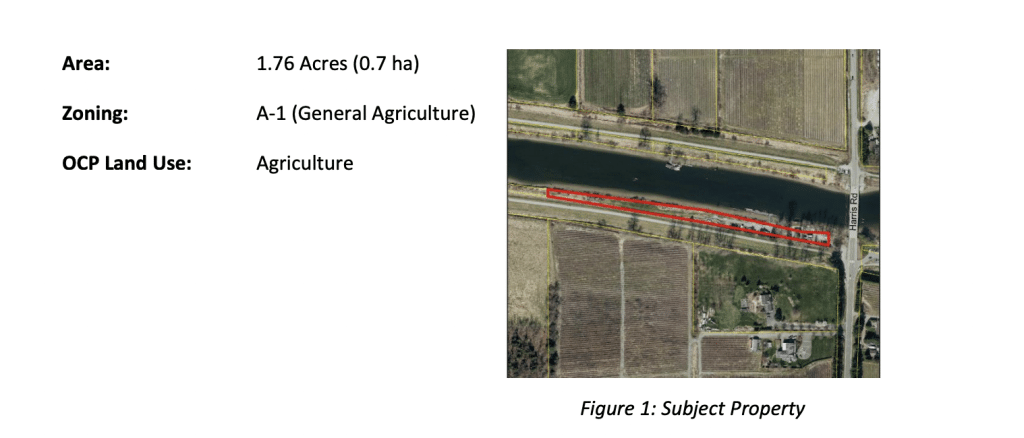
At a public meeting on Nov. 5, Pitt Meadows declined an application to permit kayaking and paddle boarding at 14411 Harris Road, a nearly two-acre property south of the Alouette River.
The Alouette Recreation and Wildlife Club, founded in 2020, were the applicants.
The club doesn’t own a business licence, but has operated on the site for four years and rented paddling gear to anywhere between five to 20 people per day — resulting in numerous bylaw infractions such as the development of buildings without a permit and illegally dumping of sand on the premises.
Approval of the application would have paved the way for the club to operate legally on the site.
However, Pitt Meadows staff and council feared creating a precedent on its valuable agricultural land.
More than three quarters of Pitt Meadows is made up of agricultural land, provincially designated spaces where farming is recognized as the main use. The city, the sixth busiest agricultural producing municipality in B.C., makes up roughly 20 per cent of the province’s blueberry production, according to its own data.
It’s important to protect farmland because of the irreplaceable changes that occur once it’s converted to non-agricultural uses, wrote Carla Stewart, a senior planner focusing on agriculture and food security at Metro Vancouver, in an emailed statement to The Ridge.
Broadly speaking, non-agricultural activities can harm farmland by impacting soil health, introducing new chemicals and large swaths of people in rural areas.
“Increased public access can lead to conflict with farm operations, traffic safety issues, and drive up costs for farmers,” Stewart wrote.
In 2002, B.C. created the Agricultural Land Commission (ALC), an independent body that advises decisions on the future of agricultural land, which makes up just five per cent of total land in the province. Both the ALC and local governments have oversight on agricultural land.
The lot at 14411 Harris Road was created around 1920 and is privately owned. The property sits within agricultural land, but ALC rules don’t apply to the site as it was subdivided before the ALC act was created.
There is a need for more kayaking and paddling opportunities on the Alouette River, according to the city’s Official Community Plan (OCP). Pitt Meadows’ Parks, Recreation, and Culture masterplan, finalized and adopted in 2021, also identified a need for recreation paddling club use in the city.
But the planning process for recreation and agriculture space is a tricky act to balance, said Colin O’Byrne, the city’s manager of planning. Although the OCP clamours for more recreation, other policies within the document underscore the importance of protecting agricultural spaces.
Ultimately, he said, the club’s application may act as a model, encouraging others to apply for similar recreation permits in areas primarily zoned for agricultural use.
“Creating a spot land commercial use designation, and zoning amidst surrounding agricultural land, is not supported by these policies and may be considered a precedent,” he said, adding there are other infrastructure concerns that could further complicate the rezoning application.
The city could not guarantee that a water connection would be established to buildings on the property, due to the challenges of providing those sorts of amenities on land primarily identified for agriculture.
The site would need a water meter, detailed development plan and driveway access, among other improvements to fall in line with the city’s policies.
There were also many other logistical hurdles to legalize the club’s operation on the river. The club still requires provincial approval to permit commercial recreation on the river.
O’Byrne suggested the Alouette Recreation and Wildlife Club apply for a temporary use permit to operate legally on the site in the meantime, like what the Alouette Paddling Club did in 2022 to validate its business on the north side of the river.
Coun. Bob Meachen, the only councillor to vote against the motion, questioned whether the temporary use permit would require many, if not all, of the mandates needed for the original rezoning application.
“The step they would skip at the moment would be the amendment to the OCP and zoning bylaw, the rest would hold,” O’Byrne said, meaning the club would still require a business licence, development permit and provincial approval before obtaining a temporary permit.
Frederik Crooker, owner of the Alouette Recreation and Wildlife Club, did not respond to an interview request by deadline.
The temporary permit would allow the group to operate for up to three years, and give the city more time to gauge its impact on traffic, agriculture and infrastructure without fully committing to a zoning change.
“This approach is consistent with the approach used for the Alouette Paddling club on the north side of the river,” stated a staff report.
The Alouette Recreation and Wildlife Club can now apply for a temporary use permit to legally operate on the site.
Author