Metro Vancouver encourages municipalities to adopt residential water metering
Pitt Meadows is one of the biggest water consumers in the region

Metro Vancouver is encouraging local municipalities to build out their water metering systems for residential units.
The meters help municipalities detect and fix leaks and encourage residents to decrease their water use.
“Across most of the region, whether you have a house with two toilets and no lawn, or you have a house with four bathrooms, a swimming pool, a hot tub, a big lawn, you’re paying the same flat rate of water,” said Linda Parkinson, Metro Vancouver’s director of policy, planning and analysis.
Fifty two per cent of the region’s water use is unmetered.
Metro Vancouver estimates that at least 12 per cent of water is wasted, based on cities’ self-reports. But Parkinson suspects the leak rate could be closer to 20 per cent, which is what the City of Vancouver recently reported due to the age of its water system and metering status.
“So the first thing metering does is it enables the member jurisdiction to address that leakage,” she said.
Once a city is fully metered, it can start charging residents for water with a pay by use rate, instead of the commonly used flat rate system.
In 2021, metered water demand for residential buildings in Pitt Meadows was at 45 per cent of total water use, and at 32 per cent for Maple Ridge. Metered demand is the amount of water used in a city that is measured by a meter.
Maple Ridge currently already does this for its metered homes, while also having a flat water rate. Pitt Meadows largely relies on a flat rate for water, charging detached homes and townhouses $817 per year.
In North American jurisdictions that have installed universal metering, they’ve seen an average 20 per cent reduction in the amount of water used per person, she said.
Water demand is expected to increase in Metro Vancouver. Not only does the region have a growing population, but climate change will impact water supply and the amount of rainfall in summer months.
“Between population growth and climate change, we need to be approaching it from both angles. We need to reduce and we need a new source,” said Parkinson.
How to expand metering?
In Maple Ridge, the city mandates that water meters are installed for a number of properties, including all multi-family and non-residential properties, newly constructed residential developments, and single-family residential properties where the service connection has been replaced.
In Pitt Meadows, it is mandated that new, replaced or “significantly” renovated homes have water meters.
Parkinson calls mandating water meters in new builds “a very quick win,” since usually the developer pays for it and it is done during construction.
“But there’s a huge amount of existing single family stock. It’s not a viable plan to wait for the turnover of all the housing in the region.”
This is where the challenge — and cost — comes in. A water meter needs to be housed in a chamber, and needs professionals to install.
“You need to mobilize a construction crew, you need to get out onto the street. You need to dig a hole to put a meter chamber in, like the meter needs to be housed in a chamber. So there’s a cost to that,” said Parkinson.
She understands that this capital cost is the biggest barrier for cities. The City of Coquitlam, for example, estimates that each water meter installation in a single-family home costs about $3,000.
“But you have to look at that and weigh it against the up to 20 per cent in water savings that you can achieve,” she said. “And then the biggest win you get there is that you can go to service the growing population.”
Davin Wilson, Maple Ridge’s Manager of Utility, told The Ridge in an email that “retrofit costs for existing homes vary depending on the property and plumbing layout.”
Metro Vancouver is a fast growing region, Parkinson explained, and if it doesn’t reduce the per capita amount of water everybody uses, it will “need to build bigger and bigger infrastructure” to accommodate the growth.
Factors that go into residential water demand
Pitt Meadows is one of the heaviest water consumers in the region. It took first place in 2023, with average litres of water used per capita per day at 601 litres. Meanwhile, Maple Ridge was at 335 litres.
But these numbers don’t tell the full story, Parkinson said. Looking at total water consumption can be misleading, since it captures both residential and business use.
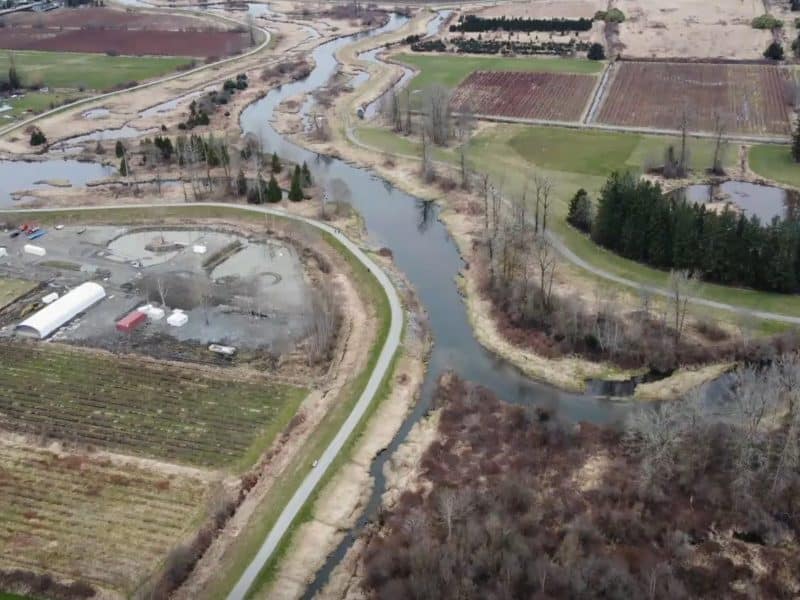
She said a city like Pitt Meadows, with its large agricultural sector, drives up their per capita demand.
“It’s difficult to compare two jurisdictions, because it’s going to be, what type of houses do they have? What’s the land use like? Is it residential? Is it agriculture? Is it business? Is it multifamily, and then also income levels, like wealthier people use more water,” said Parkinson.
While population growth is an important factor in drinking water demand, how a jurisdiction develops also matters.
Multi-family buildings use less water than single-family homes, since people in the former use less than those in the latter. Parkison said this is because multi-family homes tend to be newer builds — with things like low flush toilets — and dwellers don’t all individually have a lawn and garden they water in the summer.
Metro Vancouver estimates that residential use accounts for 65 per cent of water use in the region. In 2023, per capita consumption for the region in its entirety was 379 litres per day, but the residential demand is estimated at 246 litres per day.
The Ridge reached out to the City of Pitt Meadows and the City of Maple Ridge but did not get a response by deadline.