Summer drought impacted Kanaka Creek fish, Maple Ridge councillor says
Hot weather led to temperatures exceeding 21 C in Kanaka Creek
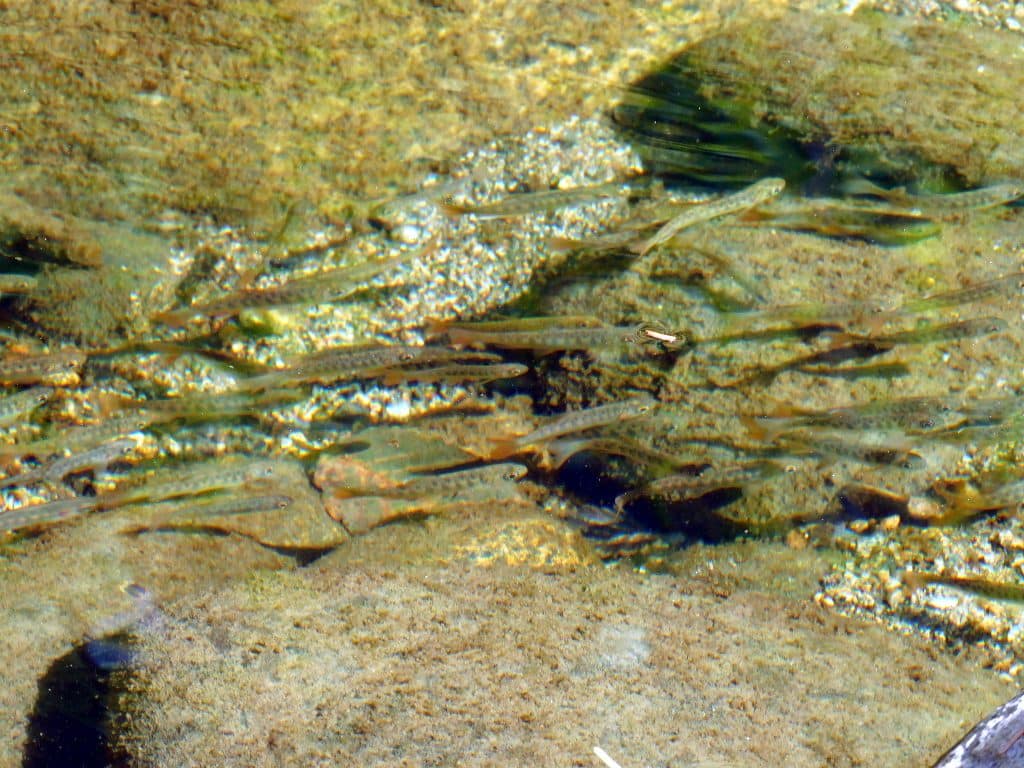
The water temperature in Kanaka Creek was noticeably higher than normal this summer and impacted fish activity, according to one Maple Ridge councillor.
Prolonged hot stretches throughout the spring and summer caused the temperature in the creek to spike 2.5 C.
Dry conditions also caused water levels in Kanaka Creek to drop significantly, stated Coun. Ahmed Yousef in a report to council on Sep. 26.
“Usually, we get about 40 millmetres of rain, we got 14 mm of rain this last August,” Coun. Yousef stated.
Kanaka Creek is a tributary on the north side of the Fraser River — the creek starts near Blue Mountain, near Alouette and Stave Lake, and flows southwest into the Fraser River.
But even when the Fraser River was at high tide this summer, Coun. Yousef declared, the water level was too low for fish to enter Kanaka Creek.
Ross Davies, an education coordinator at the Kanaka Education and Environmental Partnership Society (KEEPS), said that high temperatures can put stress on a fish — causing them to exert a significant amount of energy in search of cooler temperatures.
Earlier this summer, Davies said he noticed that a number of coho salmon would crowd around McFadden Creek, a tributary in the Kanaka Creek watershed.
“They were definitely searching for water,” he said. “They can’t stop metabolizing, they’re overactive, they have no way to regulate their internal temperature.”
Other fish in Kanaka Creek, primarily cutthroat trout, seemed to be more tolerant of the water temperature and flow, Davies said.
A recent stretch of rain has restored a solid water flow in the creek. However, Davies wouldn’t say that the flow is back to normal for this time of year.
“The rain definitely woke it up,” he said, adding that the water temperature is back to around 13 to 14 C after reaching a peak of 21 C this summer.
Davies added that Kanaka Creek relies on tributaries, instead of snow packs, to cool down the river.
“A number of tributaries are fed by groundwater,” he said. “So the function of the tributaries is they cool down the mainstream all summer long.”
Before the recent rainfall, KEEPS was looking at the possibility of accessing more groundwater from a well on their property to stimulate water flow in Kanaka Creek, Yousef explained at a council meeting earlier this week.
Metro Vancouver is currently looking to see if there are more well water sources in the Kanaka Creek watershed, Davies said.
“There’s three ways to combat hot, dry conditions: reducing your fish density, increasing your oxygen, or increasing your flow,” he said.
“If you get into well water, you can lower your water temperature and increase your flow.”
But no additional well water sources have been identified, Davies said.
Adapting to climate change
KEEPS, which was founded in 1997, helps run a hatchery, the Bell-Irving Hatchery, on Kanaka Creek with Metro Vancouver and the Department of Fisheries and Oceans Canada.
Every year, the hatchery nurtures coho and chum salmon, and distributes salmon fries to many creeks across the Lower Mainland.
As climate change increases the likelihood of more unpredictable weather seasons — including warm, dry summers — Davies said KEEPS may have to make adaptations to the hatchery.
“We may have to reduce production at the hatchery to suit different water levels, or release strategies, but we haven’t made wholesale changes yet,” he said.
“We’ve got through the summer, so we’re basically taking it one season at a time.”
But he also said the fish in Kanaka Creek are more resilient than people think.
So far this year, he has seen a significant return of pink salmon from the Fraser River.
Those salmon were also offspring from fish that laid their eggs in Kanaka Creek during the series of atmospheric rivers in 2021.
“They found a way,” Davies said.
Author