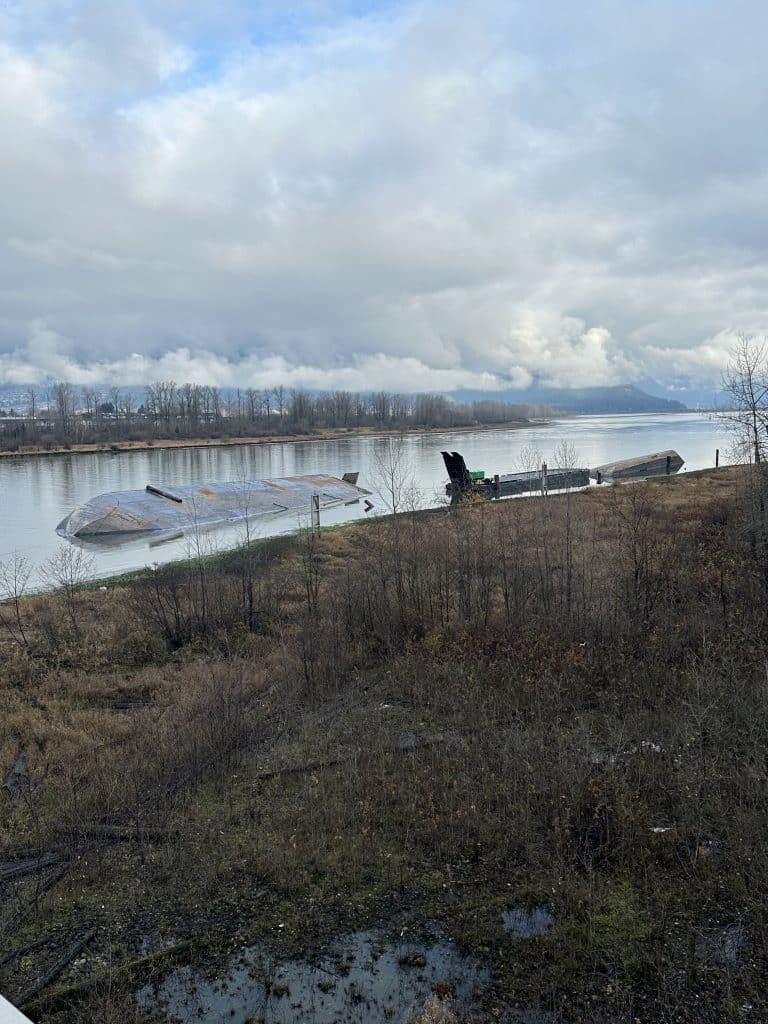
Two barges sinking in Pitt River, one week after Katzie-led restoration program announced
Capsized barges could harm Pitt River ecosystem, advocates say
There is not much that surprises Mark Caros on his weekly visits to the Pitt River Dyke Trail.
Born and raised in Maple Ridge, Caros practically grew up on the dyke. He has walked, biked and ran along the Alouette River for years, becoming familiar with its bends and curves like the back of his hand.
Caros, a board member at the Alouette River Management Society (ARMS), has also grown accustomed to seeing eyesores on one of the region’s most popular outdoor attractions: derelict boats.
So, last month, he wasn’t shocked to receive a tip about a pair of capsized barges in the Pitt River, slightly north of the Pitt River Bridge. The barges aren’t abandoned or derelict. But over the last few weeks, they have slowly started to dive deeper and deeper into the river, leading him to fear for the local ecosystem.
“It’s all sensitive fish habitat,” Caros said. “I’m just wondering how two barges, of a different make and model, happen to be more or less sinking at the same time.”
The answer will be determined by the Vancouver Fraser Port Authority, a federal agency that looks after waterways connecting to the Port of Vancouver.
The port authority has jurisdiction over the two barges, according to a release from the City of Pitt Meadows earlier this week. (Caros alerted the city about the barges.)
The barges are owned by Heidelberg Materials, a cement company with more than 450 locations across North America, according to Arpen Rana, senior communications advisor for the Vancouver Fraser Port Authority.
The Port Authority is currently working with Heidelberg Materials to remove the barges, which are located on the shore of the Pitt River. The federal agency claims they aren’t harming wildlife or activity on the river.
“The barges are property secured and pose no navigational or environmental risks,” Rana wrote in an email.
However, the Pitt River shoreline has vulnerable rearing habitat for juvenile salmon, says Katzie First Nation Councillor Rick Bailey. Any impediment in the lower half of the watershed could impact the nation’s salmon restoration efforts throughout the Pitt River watershed.
“Salmon are a high priority in my book and they don’t need another obstacle to get by,” Bailey said.
A little more than one week ago, the nation announced it had launched a large restoration project in the Pitt River watershed. The project, one of the biggest in western Canada, pledges to bring salmon back to the Red Slough, an iron-rich area in the upper portion of the Pitt River watershed.
He said he hopes the barges are removed quickly and aren’t leaking any chemicals into the river, which could impact the health of salmon, a species that has historical importance to the nation.
“We consider them part of our family,” Bailey said. He noted that within the past 20 years there have been an estimated 70,000 sockeye salmon identified in the upper Pitt River. Although that number has fluctuated in years since, thousands of salmon still call the watershed home.

The Vancouver Fraser Port Authority did not provide a timeline for when the barges will be removed.
The owners were planning to transport the barges to a Vancouver Island ship breaking business, Caros said the Port Authority told him weeks ago. Shipbreaking is a process where raw materials — scrap and other sources of recyclable material — are broken down and reused.
“That’s the plan. Now is that three days, three months, three years? I don’t know,” Caros said.
But Caros now questions how the barges will make it to Vancouver Island in their decrepit state. As of Tuesday, one barge was grounded and leaking air, which hints at something within the barge being compromised.
“When it was at least floating it could have been pumped and dragged a lot easier than it is now,” Caros said. “Now it’s going to have to be a salvage operation and I’m sure there’s some degradation to the river bottom.”

The Pitt River is tidally-influenced by the Fraser River, meaning the height of its water fluctuates throughout the day. The longer the barges stay in the water, the more likely the changing tide will rock the rafts along the shore.
The river also serves as a conduit for fish to come into the Alouette River, said Greta Borick-Cunningham, executive director of ARMS. So the health of the Pitt River has ecological impacts on the adjacent Alouette River.
“The healthier it is as a system, then it’s obviously better for our Alouette salmon as well,” Borick-Cunningham said. “Anything that isn’t natural that capsizes into the river is not going to be environmentally friendly.”
This incident is not the first one to make headlines in the local watershed this year. In February, Transport Canada contracted a crew to remove about 200 tonnes of junk out of the Alouette River, following advocacy from ARMS and the Dead Boat Disposal Society.
Author