Why Rain Pierre uprooted his life to follow his artistic dreams
The Katzie First Nation artist is hosting his first solo exhibit in Pitt Meadows this spring

Once upon a time there was a little boy who heard a sound coming from a door.
About 30 years ago, inside his grandfather’s house in Chehalis, B.C., the little boy, Rain Pierre, walked up to his parents, aunts and uncles, clamouring for their attention.
“Do you hear that sound too?” The then-four-year-old Pierre asked.
Everyone he approached shook their heads and went on with the family reunion.
But Pierre, a member of the Katzie First Nation, was determined to find out what was causing the buzzing noise in his head. So, he went outside. After taking a few steps on the back porch, he noticed a hummingbird with its beak stuck in a screen door.
Pierre plucked it out and the buzzing stopped. He held the bird in his hand. After a few seconds the hummingbird shook its head and disappeared into the neighbouring forest.
The same year, two similar incidents happened.
First, Pierre was at his auntie’s house — also in Chehalis — when he picked another hummingbird out of a window screen. It blinked at him before flying away. The second incident happened at his home on Barnston Island. Pierre was walking on his porch when a hummingbird flew into his head and fell to the ground.
Shocked, the four-year-old boy picked the bird up, inspecting it for injuries. However, once again, the bird looked at him and flew off in a matter of seconds.
At the time, Pierre had no clue about the historical significance of these hummingbird encounters.
Hummingbirds are messengers of joy and symbols of good luck, according to the Cedar Hill Long House, a Victoria-based art gallery featuring Northwest Coast Native Art. It would be years before his Elders would tell him that it’s lucky to see even one hummingbird — three sightings in that short of a timespan was out of this world.
Pierre then went a while without seeing another hummingbird.
But around the age of nine, his family took a camping trip to Pitt Lake. One night, Pierre forgot his flashlight and had to retrieve it from a nearby cabin. As he was walking back to his family’s tent, with the flashlight in hand, he heard something ricochet off a tree.
Pierre ventured into the woods to investigate the sound.
He sprayed the flashlight in the dark, illuminating the forest. A sudden flutter in a pile of leaves captured his attention. He placed his flashlight down and raced over to the earthy-coloured mound. Reaching with both hands towards the ground, he pulled out a hummingbird — its tongue was out of its mouth and its breathing slowed and slowed. It took its final breath, closed its eyes, and died in his hands.
Tears dripped down Pierre’s face. He gently placed the hummingbird back on the ground, covered it with leaves and flowers, and returned to camp.
As Pierre grew up and questioned his path in life, he never forgot the four hummingbirds that visited him in his youth.
He just didn’t know what they were trying to tell him yet.
Carving his own path
Before Pierre was born in the early 1990s, both of his parents were forced into residential schools, institutions that removed roughly 150,000 Indigenous children from their homes between 1880 and 1996. The goal at these government-sponsored schools was to assimilate youth into Canadian culture and ‘kill the Indian in the child.’
When Pierre got older, his father tried to teach him and his four older brothers everything the residential school system tried to erase from his mind: gillnet fishing techniques on the Fraser River, catching salmon, hunting.
Pierre was never as good as his brothers at fishing or hunting. But he found his own ways to contribute.
On warm summer days, as his family members sought salmon in the mighty Fraser River, Pierre used a permanent marker to draw animals on rolls of paper towel. He drew salmon and eagles, whatever came to mind, and left the designs beside his father, who was always appreciative of his drawings.
“I would challenge myself to have drawings done on the paper towel by the time he was picking up the net,” Pierre said. “That was my contribution to fishing, other than eating the snacks and taking naps.”

However, at the time, art was just his hobby. As the youngest of five brothers, Pierre always felt like he had to one-up his siblings.
From adolescence to adulthood, each of his brothers has followed a clear and fruitful career path. One is a paramedic and another is an actor in Toronto. His third brother is an archaeologist and environmentalist, who studied to be an electrician. After a tenure as a firefighter, his fourth brother teaches Indigenous communities how to deal with emergencies.
In his early 20s, Pierre went to school to become a civil engineer. This choice, he thought, would be his way of doing something big, compared to his brother’s lofty career choices.
After graduating, he quickly made a name for himself in the industry, designing bridges and highways by the age of 22.
“I was always the youngest project coordinator and always the only First Nation person,” Pierre said.
After about four years in the business, however, Pierre started to second guess why he went into civil engineering in the first place. Although he was rising up the ranks, executing plans and contracts for multi-million dollar projects throughout B.C., he didn’t feel any sense of purpose in his work.
“There was something missing in my heart,” he said.
“The closest I can say is that it felt like spiritual suicide.”
Finding art, in the dark
Pierre was at BC Children’s Hospital, inspecting a wall, when he took a selfie in front of a mirror. It was October 2016, and as he looked at himself in the mirror, he didn’t like what he saw.
“I looked sad and rundown,” he said. “I was like ‘something’s got to change.’”
That same day, when he went home from work and took off his hard hat, steel toe boots and safety vest, he started scrolling on his phone.
“I was sitting there and somebody shared a video of spray painting,” Pierre said. “He did this street art, it was so fast and so beautiful. It was like my heart woke up.”
Pierre hopped in his car and picked up painting supplies. When he came home, he pulled a canvas off his wall and painted it white. He put in a pair of headphones, queued up a motivational speaker, and started to paint.
Hours later, at around 5:30 in the morning — the time when he normally prepares to go to work — Pierre burst into tears after finishing his painting.
“It was an elk overlooking this valley with all of these mountains and a galaxy behind it,” he said.
The next day, he showed the painting to his parents, who encouraged him to follow his dreams, whatever they may be, which alleviated his fear of leaving a well-paying job with benefits to become an artist.
“My mom said to me, ‘If anyone can do this, you can.’”
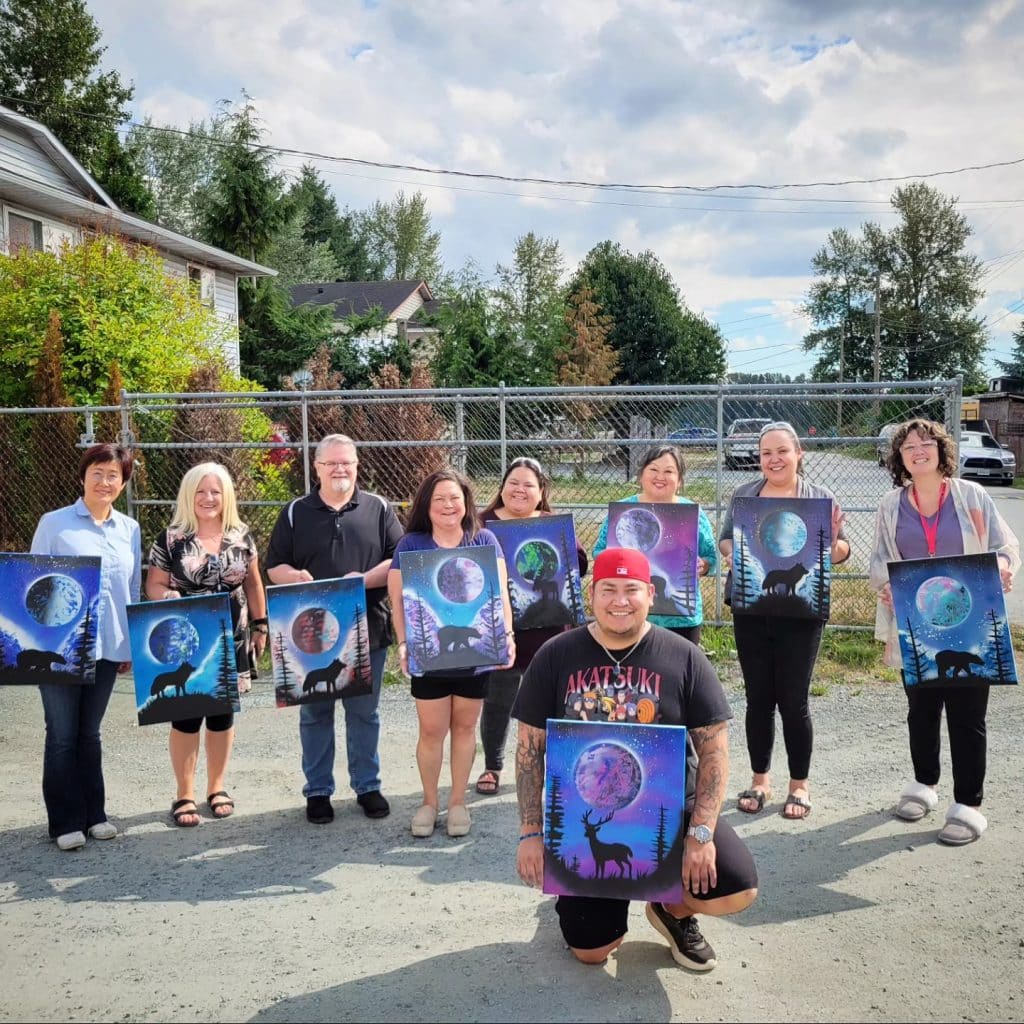
Two days later, Pierre quit his engineering job to start his own art company, RainAwakens. After seven months of honing his craft, he started commissioning his work through public art calls and competitions.
Since launching his business in 2016, Pierre has created murals for schools and organizations — such as Metro Vancouver — across Ridge Meadows and the Lower Mainland. He’s also taught Katzie First Nation staff how to spray paint and started to give motivational speeches.
“I always look up to my dad because he’s a speaker [of his Indigenous past], now I do motivational talks, trying to inspire people to follow their dreams and passions, opposed to money,” he said.
On March 12, Pierre is set to host his first solo exhibit at the Pitt Meadows Art Gallery. The exhibit, which is scheduled to run until Apr. 5 and coincide with the re-opening of the relocated art gallery, is going to feature art installations, 3-D wood sculptures and carvings, among many other elements.
A lot of his previous work has been for clients, Pierre said, so the upcoming exhibit will reveal more about himself — specifically, how he expresses himself through art.
Many of the designs for the exhibit are spiritual and not from this realm, but one animal is going to play a prominent role in the show.
Ever since he was a little boy, and especially as he navigated the meandering path of life, Pierre has felt four hummingbirds floating over his shoulder, guiding him forward. Years ago, his Elders told him the number of hummingbirds that visited him was unheard of — truly out of this world.
He hopes the exhibit, which will feature many animals and spirits from different realms, will show people his Indigenous roots. Residential schools and reserves, he said, robbed his people of being able to express themselves without judgment.
Now, he’s trying to showcase the power of art and connecting with your inner spirit animal.
“This is going to be the first time that people will see what goes on in my head,” Pierre said.
“It’s very vulnerable.”
Author