Q&A: Final rapid bus approval stalling Lougheed plans, says Maple Ridge mayor
In an expansive interview with The Ridge, Ruimy shared the importance of BRT to the growing community, among other topics
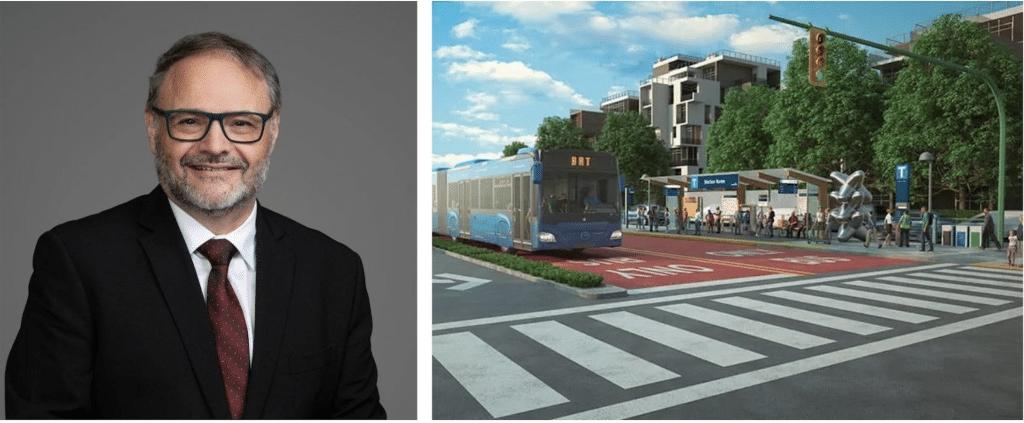
Bus Rapid Transit (BRT) is going to have a big impact on the future of the Lougheed Highway corridor, according to Maple Ridge Mayor Dan Ruimy.
In a recent wide-ranging interview with The Ridge, Ruimy said final approval of BRT — buses that act like rail lines with separated lanes of traffic and station-like stops — is holding up more than a dozen housing projects along Lougheed Highway.
Implementing the new form of transportation, should it ultimately be approved by the Mayor’s Council, may alleviate other areas of concern in Maple Ridge such as traffic and affordability.
Halfway through his term as mayor, Ruimy also chatted about council’s biggest achievements, safety and housing in Maple Ridge.
This interview has been lightly edited for clarity and concision.
The Ridge: What would you say are some of you and your council’s biggest achievements two years into your term?
Ruimy: There’s so many things. It’s no secret Maple Ridge, like many other cities, have struggled with processes, building permits and applications. So for me, my goal, our goal, was to modernize everything we do here in Maple Ridge. That started off with changing the structure of city hall. Part of that was the reorganization, the rebranding, the logo and brand statements: ‘Bold by Nature,’ ‘Driven by Community,’ ‘A City on the Move.’
That really is what started the process of modernization, because we have to ask ourselves, anything we do, we must come back to one of our statements. ‘Bold by Nature’ refers to out there [points outside his office window] but it also refers to the decision making process. So we have to do things that may not be popular but are the right things to do. That’s a piece of the puzzle, we had a bunch of activities planned: Rock the Blocks, BC Summer Games, ‘Our Neck of the Woods.’ What we showed there was that we live in a community that does have pride in where they live. And that’s part of that culture of change. Stop focusing on the negative, negative happens everywhere, but let’s focus on the positive…
One of the other things is BRT. It’s in the Mayor’s Council’s 10 year plan. However just because it’s in the plan doesn’t mean it’s going to happen. We set out a campaign, part of Maple Ridge Moves, and we lobbied. I lobbied every single mayor to say, ‘here’s why we want it’ and how important it is to the community — one of the fastest growing communities in B.C.
Why did you think BRT was important to add? Was addressing population growth the main reason?
It’s a little bit of everything. We know that being here in the suburbs, transit is ehh. We don’t have SkyTrain. That’s a 10 year conversation, which has not happened in the past and is very expensive. When we look at the transit we have, it’s OK, it’s not the greatest. It’s not going to tell people to get out of their cars. If you look forward, and see if our [population] rates continue — and they have been steady, 10 and a half per cent every year — in the next 10 years we’re going to get another 20-30,000 people.
It doesn’t take a scientist to sit back and say, ‘Where am I going to put all these cars?’ You can’t widen the roads, you can’t widen Dewdney Trunk, you can’t widen Lougheed. How are we going to be able to move around in the future when one accident blocks up everything? So having dedicated bus lanes, which won’t take away any lanes, we’re going to expand a little bit on each side, it’s going to be a dedicated bus lane going from Haney to Langley. Once it’s built, you’ll have buses going every 12 to 15 minutes.
I guess then it’ll connect with the Surrey SkyTrain extension too.
It’ll hook up with the Township’s SkyTrain. So what that allows, effectively, people who live here and work in Langley can take transit, reliable transit, and vice versa. People who live in the Township can take transit to come here, do things and visit our tourist hotspots. It’s all about getting people onto transit. It’s not about we don’t want you to drive a car. Everybody has a car these days. The reality of what we’re experiencing right now is you’re going to get more and more traffic, and when you have that one accident, that’s a problem.
The next step is the Maple Ridge Moves campaign, which looked at the whole thing if we have BRT, Lougheed, Dewdney Trunk and Abernethy [Way expansion]. If you get off the bridge, it’s one lane on either side. All the way up to 210 [Street] that road belongs to TransLink. People look at us and go, ‘why is it one lane?’ It’s not us. It’s TransLink. The cost to widen it is actually not much. It’s a matter of getting it into the capital plan. Maybe it’s $15 million last I saw.
But also at 210 [Street] is where Old Dewdney [Trunk Road] comes up. Now you’ve got single lane traffic this way, single lane traffic this way and it’s easy to see where you’ve got bottlenecks.
We’re widening 224 [Street] to 232 [Street] and the next phase will ultimately be going to 256 [Street] where we have 600 acres of industrial lands. That’s a big piece — it’s going to take some time to get there, but it has to be a priority. Ninety-three per cent of our tax base is residential. We can’t keep putting that kind of burden on the taxpayers. Yet we can’t cut back because we’re always behind the eight ball. If you can get out to 256 [Street], now you start to put in some good businesses that are hiring people locally, paying taxes locally.
If I can circle back to BRT, blue sky scenario, when can residents expect to have BRT fully functional?
We’ve got to do our capital plan for next year. The first phase with all the research and drawings, I believe that’s already taken care of, the target is the end of 2026 when we’ll have plans. And then by my understanding, it may take up to two years to build it from end to end, so it will probably be running in 2028.
How many stations are there for the BRT?
Along Lougheed, initially, there were going to be two. Now they’re talking about four.
You mentioned people moving here and growing. Obviously a big part of that is going to be housing. We had the provincial housing legislation come in last year. Broadly speaking, what is Maple Ridge’s stance when it comes to adding housing? And what would you say to residents who feel like adding more housing changes the characteristics and makeup of Maple Ridge?
Maple Ridge has always been single family homes. There’s no shortage of that around. Where we have challenges are rentals. We have a vacancy rate of less than one per cent. But it’s not easy. We can’t mandate anyone to do rentals. When we look at this, there are areas we have to be careful of like Silver Valley — a beautiful area but there’s not a lot of infrastructure there and the roads aren’t very big.
It sits next to Golden Ears Park, which is the busiest provincial park in B.C. So in the summer and there’s an accident, there’s traffic jams. We recognize that and have to figure it out. We’re working to build a bridge by 240 [Street] so that’ll give you another exit out of Silver Valley.
While we’re considering building, we also have to consider the infrastructure that’s there. We’re trying to push the downtown core. That’s where you want to densify, especially along the BRT route. Right now, you drive down Lougheed and you see single level commercial or small single family homes. But the ability to densify there is a lot greater.
What’s the timeline on the 240th Street bridge project?
Again, we’re hoping to have plans. I don’t know if we’ll get them by the end of this year. Hopefully we have them in the next few months. Once we have the plans, we’ll be able to figure out what it’s going to cost. It’s not federal, it’s not provincial, it’s municipal. So we have to pay for it. We haven’t had much luck yet getting anything from senior levels. It’s not surprising because in order to get something, you have to have a plan. It’s like me going to them and saying, ‘give me $20 million and I might get the bridge done.’
Any government is going to sit back and say, ‘well, is it a shovel ready project?’ If it’s going to take you 10 years to put the bridge in, they’re not going to commit $20 million to it. We’ve got to do our part, like everything else.
One initiative that did go up this year was the ‘Be Downtown’ initiative. What was the reaction from that over the summer and past few months?
When we talk about petty crime, that’s what this is right, there’s a tendency to blame all the homeless people.
We have a population that just broke 100,000 people, and we have documented 134 homeless people. We do have shelters. We do have supportive housing. There’s this tendency that when something goes wrong, let’s blame the homeless people. But homeless people don’t go around in giant pickup trucks stealing from your neighbours. And then there’s this notion that people are afraid. I had a gentleman come to council twice. First time it was at a committee of whole and I was sitting on the side so I couldn’t speak. Second time he came when I was in the chair and demanded to know if I was afraid to walk the streets.
I said, ‘I live two blocks away. My partner lives two blocks away. We have a little puppy. We walk morning, afternoon and nighttime. No we don’t. We don’t see anything for us that threatens us.’
Having said that, I recognize people do feel [fear]. It’s very subjective. What scares me may not scare you. That just tells me we need to do more. Last summer, we did Project Dovetail with the RCMP. That was reintroducing walking the beat downtown. The two months we did this project, shoplifting was cut in half. That said something. Having police presence calms things down. So we did another push when the video in Tim Hortons…
That was last winter? (A group of men were caught smoking drugs in a Tim Hortons in March)
Yeah. It is what it is. At that point we were doing another project similar to Dovetail, that’s when we came up with the Be Initiative. The point of that was to not only show a presence but to answer questions. We have RCMP, we have the BIA, chamber, bylaws, community safety officers, private security patrolling downtown at nighttime. But we can’t be everywhere. I see somebody got broken into at 4:00 in the morning and the comments on social media were ‘why weren’t the police sitting there, waiting for that to happen?’ It doesn’t work that way.
Sorry, confirming from earlier, did you mention 34, or 134 documented homeless?
One-hundred and thirty-four. Which in of itself is not an outrageous number compared to other communities. When we look at stuff like that, it’s until the province and federal government have the political will to spend the right amount of money on putting up facilities. It’s not just treatment and recovery, it’s more than that. Drugs, which are entrenched, in some cases mental health issues, which have been lifelong issues. The whole poverty piece: ‘I got nowhere to live,’ ‘there’s no rentals out there.’ These all contribute to the housing issue to the homeless issue.
Not every homeless person is an addict and that’s something that needs to be spread around. You have seniors that no longer have a place to go because they don’t have any more money. They’re put in a situation where they’re vulnerable.
During the provincial election campaign, it was mentioned the Alouette facility was going to be one of those places for involuntary care. What was the reception you heard from residents about that?
I don’t know if it had any kind of reaction, other than it started a short lived debate on involuntary [care]. It becomes this question of can you hold somebody against their will? Can you force them to do something against their will? There’s good debate on either side. You look at Monarch Homes (the facility that will house people under the Mental Health Act), which is on the prison land but not part of the prison. As an MP I remember talking to them back in 2016 or 2017 wanting to do something with those houses.
When I met with them there were a lot of questions on our end. You’re doing six people, are they going to be able to walk around? Come downtown? Be a part of the community? Or are you adding more problems to Maple Ridge?
The reality is that these folks are the most vulnerable. The answer is that they’ll likely never leave, but I think you need those kinds of places on a much larger scale. I would imagine they’re not criminals that are being put there.
You look around here and what do you see? Some of these people are off the grid. That’s the way they live their life now. They don’t see themselves getting married, having a home, having children, having a job. It’s not part of their vocabulary every day. Their vocabulary is what am I going to eat? When am I going to get my next fix? How am I going to keep warm? Cool off? It’s a challenge, but for me, as long as you’re calling it a pilot project, let’s do it and see what the outcome is. It’s better than doing nothing… The only request I had was that some of our residents here are part of that project. And then they announced they’re going to do this in other areas, we just happen to be the first.
How would you grade safety currently in the city right now?
It’s not an answer I can give you. As I said before, safety to me is different from safety to you. If you are feeling vulnerable, say a senior who’s walking everywhere, you may look at three or four people on a street corner and think twice about walking by that street corner. It’s hard for me to say how they feel. As a city, we just need to continue to do the things that we’re doing within our capacity.
I appreciate your thoughts on that. I’m going to pivot hard to ‘Our Neck of the Woods.’ It seemed to be really popular. I’m curious if the city is planning to do similar large scale events like that in the future?
When I look around, Pitt Meadows has their Pitt Day parade. Burnaby has their Hats Off day. PoCo’s got May Days. A lot of cities have that one day of the year where they celebrate their city. I would love ‘Our Neck of the Woods’ to be a yearly event. It was so positive. People enjoyed it. And that’s part of building a strong culture where we live.
What are your main goals heading into the final two years of this council term?
You’re only as good as your last announcement. We have to keep our pedal to the metal. We want to complete Abernethy, we want to continue doing things like the spray park, which will be unveiled soon. We want to continue doing ‘Rock the Blocks’ and great community events.
The other thing is ensuring that we’ve woven in First Nations to our story, or maybe it’s the other way around, we’re weaving our story into their story. Reconciliation is important to us. I believe our role — we’re not provincial or federal — is to maintain a good relationship with them. If they’re developing their industrial lands, how do we help where we can, not take it over, and ensure that we can all enjoy this area we call home.
Getting things ready for BRT. We have general road width but the stations require extra. That’s been very intense over the last couple of weeks because we’ve got 14 projects on hold along the Lougheed corridor, which is about 2,300 units, because of BRT. But that’s a priority for the city. We need to have that or you’ll be logjammed everywhere.
Author