Pitt Meadows asks Ottawa for timeline to phase out leaded aviation fuel
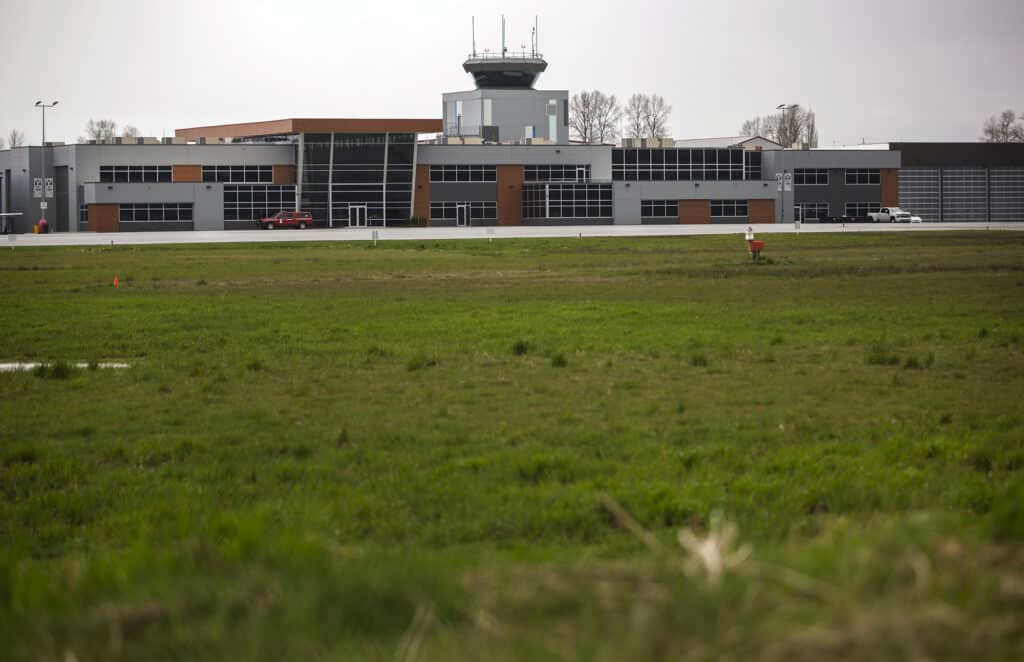
The City of Pitt Meadows is asking the federal government for clearer answers on when Canada could move away from leaded aviation gasoline, following concerns raised earlier this summer about lead emissions from aircraft operating at Pitt Meadows Regional Airport.
In an Aug. 5 letter, Mayor Nicole MacDonald, writing on behalf of council, formally asked federal Environment Minister Julie Dabrusin and Transport Minister Steven MacKinnon for an update on Canada’s approach and timeline for transitioning away from leaded aviation gasoline, including 100LL fuel.
The letter says residents have raised questions about lead emissions from piston-engine aircraft using the fuel at Pitt Meadows Regional Airport, also known as YPK.
“These concerns are being raised locally with the city, the airport, elected officials and public health partners,” the letter states. “We also recognize that any transition away from leaded aviation gasoline must be undertaken in a manner that protects public health.”
The move follows a public debate that emerged in June after Paul Kershaw, a UBC professor and longtime Pitt Meadows resident, wrote an opinion piece in the Vancouver Sun warning that growing flight activity at YPK could increase the risk of lead exposure for nearby residents, particularly children.
Kershaw pointed to the continued use of leaded gasoline by many small piston-engine aircraft and argued that the issue deserves greater attention as activity at YPK increases. Statistics Canada figures cited in the opinion piece showed the airport recorded 208,551 aircraft movements in 2025, roughly twice the level a decade earlier.
Pitt Meadows Regional Airport subsequently pushed back against some of the concerns, saying aviation fuel standards are regulated federally and that 100LL remains an approved and widely used fuel for piston aircraft across Canada.
The airport said Transport Canada was working with other federal agencies and the U.S. Federal Aviation Administration on commercially developed unleaded alternatives, but that Canada had not established a formal deadline for eliminating leaded aviation gasoline. YPK said aircraft certification, engine compatibility, fuel infrastructure and availability all complicate the transition.
The city is now asking Ottawa to clarify that situation.
Among seven questions in its letter, Pitt Meadows asks whether Canada has established – or is considering – a national target date or phased approach for reducing or eliminating lead emissions from aviation gasoline.
Council also wants to know how Canada is following developments south of the border, where the U.S. Federal Aviation Administration and industry partners have established the Eliminate Aviation Gasoline Lead Emissions, or EAGLE, initiative.
That initiative has a goal of safely eliminating leaded aviation fuel use in piston-engine aircraft by the end of 2030.
Pitt Meadows is asking federal officials to explain the respective roles of Environment and Climate Change Canada and Transport Canada in the transition, the status of work to approve commercially available unleaded fuels for Canadian aircraft and what barriers remain.
Those potential barriers could include aircraft and engine certification, fuel supplies, airport infrastructure, safety requirements, cost and availability.
Council wants information they can share with residents and whether there are steps local governments and airport operators can take in the interim.
The city acknowledged that moving away from leaded fuel has to balance environmental and public-health concerns with aviation safety, aircraft compatibility and maintaining an adequate fuel supply.
The letter also notes that city officials have discussed the issue with Fraser Health, but says neither the municipality nor the health authority is equipped to provide the technical and regulatory answers residents are seeking.
Instead, council says those answers need to come from Transport Canada and Environment and Climate Change Canada.
“The city is not seeking to assign responsibility or pre-empt the technical work required to ensure a safe transition,” the letter states. “Rather, council is seeking clear, current and publicly shareable information from the appropriate federal authorities.”
The city requested a written response outlining the federal government’s current position, anticipated next steps and information that can be shared with Pitt Meadows residents. Staff also offered to meet with federal officials to discuss timelines and the responsibilities of different agencies.
YPK has said it supports eventually adopting unleaded aviation fuel and other cleaner technologies, including electric training aircraft. The airport is also planning a carbon emissions study in 2026 to establish a baseline for emissions generated by activities under its operational control.
The airport is jointly owned by the cities of Pitt Meadows and Maple Ridge and is one of Canada’s busiest general aviation and flight-training airports.