Pitt Meadows council advances North Lougheed Area Plan to public hearing

Pitt Meadows council has moved a long-debated plan for a major new neighbourhood north of Lougheed Highway closer to reality, despite concerns the proposal could open the door to further losses of agricultural land.
Council voted 6-1 Tuesday, Sept. 1, to give first and second readings to an official community plan amendment for the North Lougheed Area Plan and send it to a public hearing.
Mayor Nicole MacDonald said elements of the proposal have been debated for more than four decades and argued the city can accommodate development while maintaining a firm boundary against further urban expansion into farmland.
“I don’t think it’s that slippery a slope when it’s been 41 years,” MacDonald said. This is a fight to get this to where it is.”
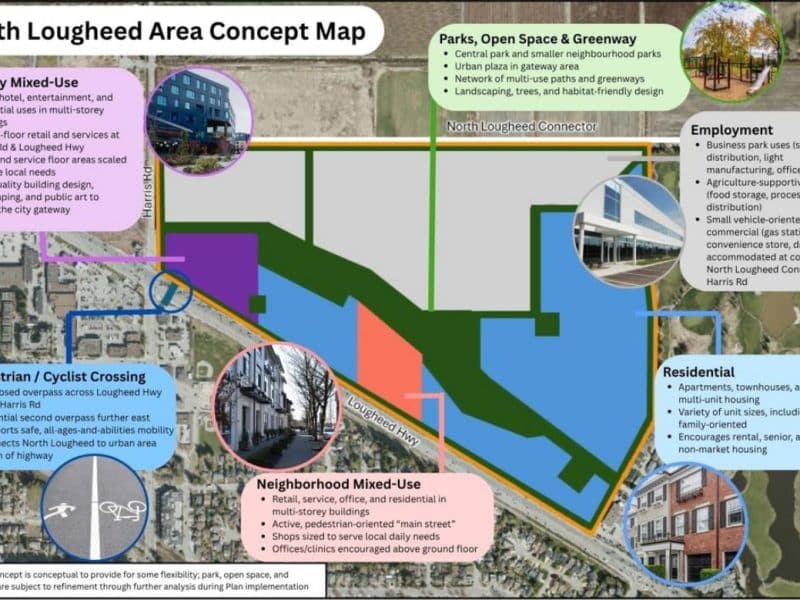
The plan covers roughly 125 acres on the north side of Lougheed Highway between Harris Road and Meadow Gardens Golf Course. It envisions a mix of housing, commercial and employment space, parks and community uses, along with construction of the long-planned North Lougheed Connector.
MacDonald said that Pitt Meadows already has nearly 78 percent of its land devoted to agriculture, noting the city is doing “some incredibly heavy lifting for food security and agriculture in the region.”
While she acknowledged concerns over allowing urban development north of Lougheed Highway, said she believes the North Lougheed development should be the limit.
“If I was involved in the future, this would be it,” MacDonald said. “We’re not going further north.”
The proposed area plan could accommodate approximately 2,200 new homes, according to a city staff report. Pitt Meadows’ interim housing needs report estimates the city will require 1,521 new homes over five years and 5,195 over 20 years.
The concept generally places residential development closer to existing homes, schools, parks, commercial services and transit, while employment uses would be located closer to surrounding agricultural land.
But much of Tuesday’s debate centred on the Agricultural Land Reserve (ALR) and whether the benefits promised by the project justify allowing development on land that was previously protected for agriculture.
Parts of the North Lougheed area have been subject to Agricultural Land Commission (ALC) decisions dating back to the 1980s. One section is already outside the ALR, while two other areas received conditional exclusions in 1985, 2004 and 2013.
The 2013 decision was closely tied to construction of the North Lougheed Connector, which would run between Harris Road and Golden Ears Way. The road is intended to divert traffic and allow traffic calming on Old Dewdney Trunk Road, improving safety for agricultural vehicles. The ALC required a firm commitment to complete the connector and implement traffic-calming measures as conditions of the exclusion.
Coun. Mike Manion was opposed, the only councillor opposed to advancing the plan, argued those transportation benefits aren’t enough to justify permanently losing agricultural land.
“Population forecasts, travel patterns, and traffic volumes are not static, and this development will take years to fully build out,” Manion said. “We will have traded a permanent asset for a temporary transportation benefit.”
He also warned that Lougheed Highway has historically provided a clear dividing line between Pitt Meadows’ urban and rural areas.
“History shows that agricultural land is rarely lost all at once; it’s lost one exception at a time,” Manion said.
Coun. Bob Meachen agreed there was a legitimate concern about development “creep,” but said portions of the area north of Lougheed Highway have already been developed and argued Pitt Meadows has few remaining opportunities to accommodate substantial growth.
“There is nowhere in Pitt Meadows we can build 1,500 homes. It simply isn’t available,” Meachen said. “This is the last opportunity we have in terms of a major development meeting the needs of this city for the future.”
Coun. Tracy Elke similarly said the project could provide more than housing and transportation improvements, pointing to new jobs, services and additional property tax revenue that could help lessen the burden on existing residents.
City staff said the area plan is expected to generate jobs and investment and expand Pitt Meadows’ property tax base, although development would occur gradually and individual projects would still require further studies and council approvals.
Coun. Alison Evans said she continues to have concerns about both farmland and maintaining Pitt Meadows’ small-town character, but supported moving the proposal forward so residents can have another opportunity to weigh in.
“It is one of the last areas left for growth in Pitt Meadows,” Evans said. “I think that’s why it’s so important that we don’t just get it right; we get it perfect.”
Coun. Gwen O’Connell said she has long supported the project, particularly because of safety concerns involving farm vehicles and other traffic on Old Dewdney Trunk Road.
The area also sits within the traditional and unceded territory of q̓icə̓y̓ (Katzie) First Nation. City staff said recent planning has included additional technical work and collaboration with Katzie to incorporate cultural context and First Nation perspectives into the plan.
The area plan would also designate North Lougheed as a Heritage Conservation Area, creating policies and a permit process intended to recognize and protect places of cultural, archaeological and ancestral significance.
With first and second readings approved, the OCP amendment will now be referred to the Agricultural Land Commission and a public hearing will be scheduled before council considers whether to move the plan further toward adoption.