Maple Ridge approves long-term plan for 500-acre industrial area
Maple Ridge has formally adopted a long-awaited plan that will pave the way for a new industrial employment hub in northeast Maple Ridge.
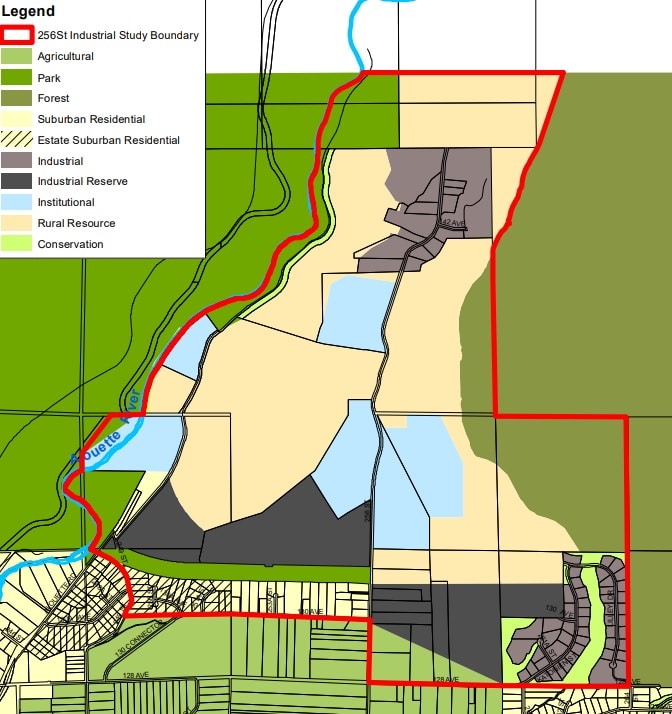
Council voted 5-1 on June 23 to adopt the North 256 Street Industrial Lands Area Plan, amending the city’s Official Community Plan to establish a framework for approximately 500 acres of industrial land on both sides of 256 Street north of 128 Avenue.
While the plan does not approve any specific developments, it sets the long-term vision for future business and industrial growth in the area.
Mayor Dan Ruimy said the vote marked the culmination of an extensive planning process that included multiple rounds of public engagement and regional approvals.
“Industrial land is in short supply across Metro Vancouver, and this plan helps Maple Ridge prepare for future business and employment growth in a thoughtful, long-term way,” said Mayor Dan Ruimy. “It supports local jobs, creates opportunities for future investment, and helps strengthen the City’s tax base so we can continue providing the services and amenities that our growing community needs.”
The area is already home to gravel extraction operations, institutional facilities, civic services and some existing industrial uses. Its location near Lougheed Highway, Abernethy Way, the Golden Ears Bridge and the South Fraser Perimeter Road makes it one of Maple Ridge’s most significant long-term employment opportunities.
The city said the area plan is intended to help address the region’s shortage of industrial land by supporting business investment, job creation and future infrastructure while protecting environmental features, parkland, trails and existing land uses.
The plan establishes future land-use designations for light industrial, institutional, commercial and conservation uses, along with policies for transportation, utilities, environmental protection and urban design.
Future developments will still require separate applications, technical studies, environmental reviews and council approvals.
Eric Aderneck, the city’s industrial lands program manager, said planning ahead is essential given the region’s shortage of industrial land.
“Industrial land scarcity is a regional economic challenge,” he said. “Planning ahead and protecting industrial lands is essential to attracting new investment to the community, supporting local jobs, and building long-term economic resilience.”
Concerns over Abernethy extension
Not all of council gave the thumbs up, however.
Coun. Sunny Schiller, the lone vote against approval, said she supports the overall concept of the industrial area but remained concerned that the plan relies heavily on the future extension of Abernethy Way, which requires Agricultural Land Commission (ALC) approval because part of the proposed corridor crosses Agricultural Land Reserve land.
She pointed to a February letter from the ALC, which stated that commission approval will be required before any right-of-way acquisition or road construction can proceed through ALR lands and recommended the area plan clarify that the extension remains subject to that approval.
The commission also recommended stronger agricultural edge-planning measures where the new urban boundary meets adjacent farmland.
“When we voted on this in January, I said I think this is a good plan and I think it can be better,” Schiller said.
While the City incorporated the ALC’s recommendations regarding agricultural edge planning, Schiller said it still fails to adequately address the uncertainty surrounding Abernethy Way.
She compared the situation to the Silver Valley Area Plan, which was developed decades ago based on a proposed provincial bridge at 240 Street that was ultimately never built.
“With the benefit of 25 years of hindsight, it seems like this plan should have been revisited when that key measure of enabling infrastructure was rejected by the approving authority.”
Schiller also raised broader concerns about the environmental impacts associated with building a four-lane arterial road through what is currently a natural area.
Environmental concerns raised
Coun. Jenny Tan also expressed concerns about environmental stewardship, although she ultimately supported the plan.
Tan said she continues to hear from residents who are worried about balancing economic development with protection of Maple Ridge’s natural environment.
She said public opinion surveys consistently rank environmental stewardship among residents’ top priorities and suggested the city could have gone further by engaging the public on the technical environmental work completed during the planning process.
“What I would have loved to see in this process is more technical engagement,” Tan said. “Other cities, I understand, have done more technical engagement work – something more than just putting a technical document on the website.”
Ruimy responded that the area plan provides the policy framework, while each future development proposal will undergo its own environmental review and permitting process.
“There’s been a lot of environmental work done on this,” he said. “As businesses move in there in the years to come, we will hold them to the same rigorous environmental standards that we do with any other business or developer.”
Years of planning
The North 256 Street Industrial Lands Area Plan has been in development since February 2025.
Council gave the Official Community Plan amendment first and second readings in January before holding a public hearing and referring the proposal to Metro Vancouver for regional approvals.
Metro Vancouver approved the required Regional Growth Strategy amendment in May, allowing Maple Ridge to proceed with final adoption.
During the process, the city conducted a three-phase public engagement program that included four open houses, a public hearing and consultation with First Nations, residents, landowners, businesses and government agencies.
According to the City, engagement participants generally supported creating more local jobs and expanding the industrial tax base while raising concerns about traffic, infrastructure timing and environmental protection.
With council’s approval, the area plan is now incorporated into Maple Ridge’s Official Community Plan and will guide future planning, infrastructure investment and development proposals in the area for years to come.