Maple Ridge staff request nearly $3 million more for 123 Avenue roadway project; taxes not increasing
Whether council officially approves the funding or not, construction is expected to start in July and run until next summer

A new road and utility project in Maple Ridge is going to cost nearly $3 million more than the city thought, sparking a debate about the need to educate the public on capital projects.
At a committee of the whole meeting on Tuesday, city council unanimously backed a motion that may increase the budget of a roadway and utility project on 123 Avenue by roughly $2.7 million.
The project, slated for construction next month and will take place between Laity and 216 Street, is aiming to create more than 400 metres of additional sidewalk space and a new 650-metre multi-use path. It also includes plans to revamp existing drainage and sanitary mains.
The road improvements come as the corridor sits between three schools — Laity View Elementary, Glenwood Elementary and Maple Ridge Secondary — and sees a high volume of foot traffic, said Jatinder Khaira, the city’s manager of design and construction.
“The road and pedestrian upgrades under this project will separate vehicle traffic from pedestrians and cyclists,” said Khaira, adding that the road is a key spot in Maple Ridge’s strategic plan to increase alternative modes of transportation.
“With this project, we will be creating some of the key walking and cycling linkages within the city.”
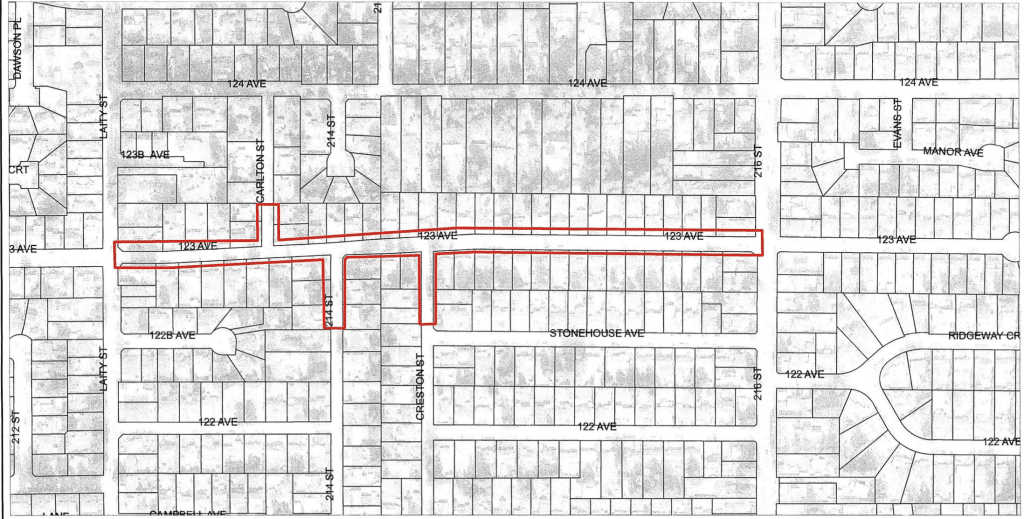
The corridor was initially built in 1964 and has not been upgraded since, according to a report to council. For more than a decade, the public has expressed concerns about the lack of safe walking and cycling space on the street, especially considering its central location between the three schools.
The city initially budgeted roughly $8.5 million for the project, which is anticipated to take about one year to complete. But higher than expected construction and market costs forced staff to request council allocate more funding for the project.
Over the past year, specifically, Khaira said staff realized traffic control requirements in the congested residential neighbourhood may be higher than they planned. The already high costs of doing construction work in the Lower Mainland, aging utilities under the roadway and $1.4 million allocated to contingency plans also raised the budget.
“In a single instance, additional driveway, landscaping restoration and utility relocation costs can be small, but we have in the neighbourhood of 50 homes along this corridor so those costs can add up,” Khaira said.
The restoration costs on a recently completed multi-use path on 117 Avenue, for example, varied from what the city anticipated during the design process, Khaira said.
“We want to minimize the impact to residents, so those costs can increase,” he said.
The project will not lead to a tax hike, however, because the money to complete the improvements will come through a reserve fund and reallocated money from already completed projects, Khaira said.
“Approximately $1.9 million will be transferred from 2023 projects that are complete and have unused budget,” he said.
Despite the pledge to not increase taxes, Mayor Dan Ruimy, who supported moving the motion to a future council meeting, said that many residents may not understand why the city missed the mark on its budget for the project.
“Even though we’re not going back to the taxpayer for that dollar amount, we’re still spending taxpayer dollars,” he said.
It’s a tricky balance to navigate, said Trevor Thompson, the city’s director of finance.
The city doesn’t want to increase the budgets for other projects — in fear of overcommitting money and reducing their ability to complete more initiatives — and these situations happen on rare occurrences.
“What council sees is only the projects that come over budget,” Thompson said. “All the projects that come under, like the savings we saw earlier, you don’t see the costs. It’s a skewed perspective.”
Every project in the financial plan is reviewed every year, Thompson added. But construction costs change per year and a project’s start date may get pushed back, leading to difficulties in predicting a budget.
“That’s the best effort we’re able to make to continually adjust those costs,” he said. “Maple Ridge is not unique in this, I think our colleagues in other municipalities are constantly dealing with similar issues.”
The funding request is expected to be discussed at an upcoming council meeting. If the request is declined, staff said that the project is expected to be complete in two phases.
Author