Maple Ridge and Pitt Meadows grapple with new provincial housing legislation
Pitt Meadows council questioned the province’s legislation in a nearly three-hour session earlier this month

The cities of Maple Ridge and Pitt Meadows are updating policies to accommodate an influx of new residents due to recent provincial legislation.
On May 14, both local governments met in separate meetings to amend zoning bylaws related to Small-Scale Multi-Unit housing, and designate Transit Oriented Demand Areas (TOA) near certain bus stops and West Coast Express stations.
As many as 14,000 lots in Maple Ridge could be the home to new fourplexes, according to a staff report in a council workshop meeting.
Roughly 2,000 more lots located within 400 metres of transit corridors — primarily along Lougheed Highway and Dewdney Trunk Road — could house six units of housing as opposed to a single family home.
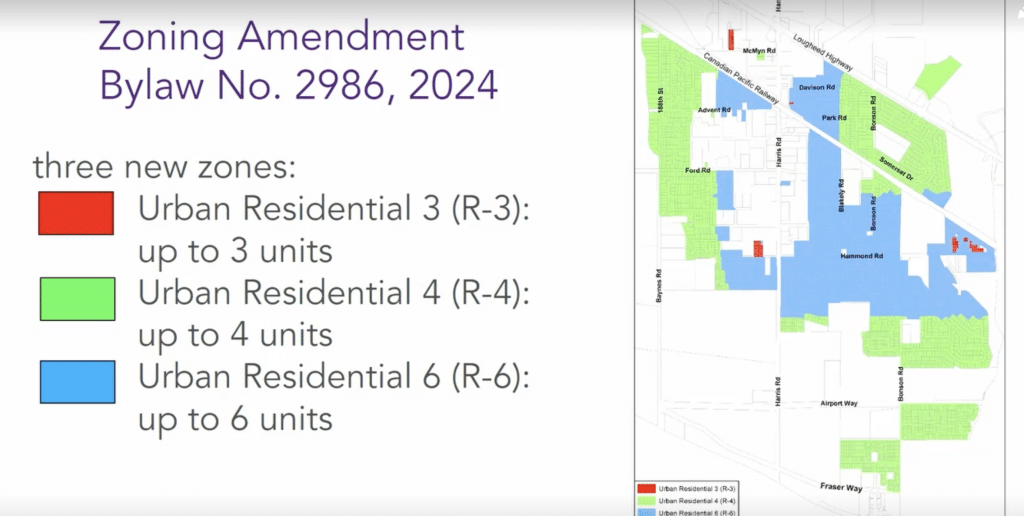
Pitt Meadows, likewise, introduced three new housing zones — R-3, R-4 and R-6 — that could convert single family areas to duplexes, triplexes, fourplexes or homes featuring six units of housing depending on the size of the lot without any rezoning.
The new builds can be a maximum of three storeys or 10 metres in height, according to Christine Carter, the city’s manager of strategic initiatives.
Both local governments shared practical concerns — parking, road infrastructure, sewage requirements among other issues — related to the recent provincial legislation.
However, a majority of Pitt Meadows councillors were upfront with their displeasure about the provincial mandates, citing character loss and an expedited approval process that removes critical public engagement processes.
“This is an example of complete provincial overreach into the local government process,” said Mayor Nicole MacDonald. “Ironically, when the goal here is increased housing and affordable housing, I think the consequences in many places are going to be the opposite effect.”
The changes are due to a provincial bill, which was passed last year, aiming to increase housing supply in B.C.

The legislation requires municipalities to change guidelines that will facilitate the construction of three to six units of housing on single family lots — depending on its location — and secondary suites or detached housing units on single detached zones.
Specifically, under the new zoning rules, both cities must permit up to three units of housing on single detached or duplex lots that are smaller than 280 square metres, four units on lots between 280 and 4050 square metres, and six units if the lots fall within 400 metres of a prescribed bus stop.
Developers can seek to build more than six units in the prescribed bus stop zones.

There is “no one size fits all” plan to address parking and infrastructure concerns among cities in the Lower Mainland, said Maple Ridge Coun. Korleen Carrreras.
But she said it’s important that the city continues to advocate to the province to address recreation needs and a lack of school and hospital space as the community continues to grow.
Maple Ridge Mayor Dan Ruimy said every mayor in the Lower Mainland is grappling with how to implement these housing measures in their community.
“We’re all on the same page, how do we advocate for more infrastructure dollars? How do we advocate for the things in our community? We’re all struggling in the same way,” Ruimy said, adding that staff and council are exploring how to best advocate to the premier, MLAs, or prospective representatives as a provincial election is slated for the fall.
Maple Ridge has received more than $583,000 to implement the legislation, according to an article published in the Maple Ridge-Pitt Meadows News earlier this year.
Pitt Meadows, meanwhile, has received more than $241,000 from the province to help with the housing legislation, according to a report to council. And adopted a program, Amenity Cost Charges, offered by the province that allows local governments to collect funds for amenities such as community centres from new developments.
In Maple Ridge, three transit hubs — the West Coast Express’ Maple Meadows Station and Port Haney Station and the Haney Place Exchange — have been designated as TOAs, meaning all new builds within 400 metres of the hubs will require at least six units of housing.
All residential off-street parking must also be eliminated in those zones.
A handful of other bus stops between Maple Meadows Station and the Haney Place Exchange have been marked as TOAs.
The province pointed out two TOAs in Pitt Meadows: Pitt Meadows and Maple Meadows Station.
Pitt Meadows Coun. Alison Evans was curious why the province considered West Coast Express stops as TOAs, considering it doesn’t act like a SkyTrain or RapidBus which runs constantly throughout the day.
“I love the West Coast Express… But I’m also a shift worker and it does not work for shift workers,” Evans said.
“If we got a SkyTrain, I could understand that being considered, but it’s disappointing they’ve considered the West Coast Express because it does not serve all the people of Pitt Meadows.”
Both communities will also complete a housing needs report, as per another requirement in the legislation.
Adoption of the bylaw amendments are officially expected to take place next month.
Author