
Golden Ears Park repairs expected to cost $5 million after last fall’s heavy rain damages trails and road
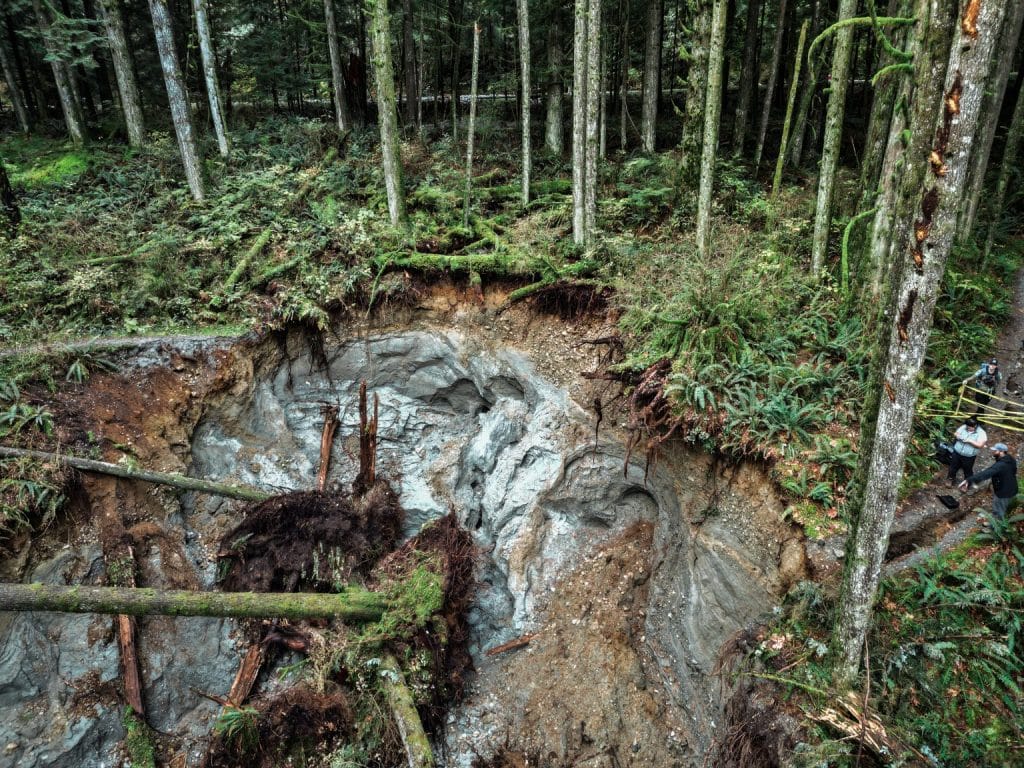
Golden Ears Park camping reservations and vehicle access reopened this week after being shut down last October due to an atmospheric river.
Repairing the damaged trails and sections of the Golden Ears Parkway will likely cost around $5 million, according to the BC Ministry of Environment and Parks. However, a ministry representative told The Ridge in an email: “There is still work to do and we don’t have a final number yet.”
On Wednesday, reservations opened for Gold Creek, Alouette, and North Beach campgrounds. Campsites at Gold Creek are set to become available starting March 28, and at Alouette and North Beach by April 16.
Since last fall, the ministry has worked with engineers to assess the damage and design reconstruction of both the road and long-term water control, according to a statement to The Ridge.
The heavy rains caused a number of landslides, debris flow, and even a large sinkhole that damaged various trails in the park.
BC Parks has finished the necessary repairs to open the road, but are still planning more road and creek repairs. They’ve focused on fixing the road to open it up for the public, and will now focus on longer term repairs, including the trails.
Visitors should expect traffic delays because a small section of road to access the northern park (including campgrounds) will be single-lane alternating traffic. The road should be fully open by May.
Climate change
The ministry also said they’ve invested in infrastructure that will be more resilient in the event of future storms, like a culvert installed in a tributary of Gold Creek with greater capacity to manage increased water volume and frequency.
Parks, including Golden Ears, are at the forefront of climate change’s impacts amid wildfires, floods, droughts, and more, the ministry stated.
With increasing carbon pollution, climate change has been exacerbating existing weather patterns, making them more frequent and extreme, according to Isabel Siu-Zmuidzinas, a climate campaigner for environmental advocacy group the Wilderness Committee.
“Climate change is unprecedented,” she said, “The global warming, and these weather events, we couldn’t have predicted these 10, 15 years ago – even five years ago.”
“Our infrastructure’s just not set up for this type of extreme weather that we’ve been seeing, whether that’s in parks, or it’s in our cities, or anywhere,” Siu-Zmuidzinas said.
The ministry said they are: “constantly looking for ways to build and improve park infrastructure to better withstand future extreme weather, which is becoming more frequent and severe.”
When possible they will repair damaged trails in a way that makes them more resilient to extreme weather events.
Related Articles

Metro Vancouver encourages municipalities to adopt residential water metering
Pitt Meadows is one of the biggest water consumers in the region

How an experiment in Maple Ridge is helping change B.C.’s logging status quo
From clearcuts to cut-to-length