Lights, Camera, Discussion: Maple Ridge exploring film production changes
Under the proposed rules, film companies will no longer be able to shoot at six locations under one permit
Maple Ridge is looking to update its policy for film production in the city for the first time in nearly 30 years, following unanimous approval from council on Tuesday.
The bylaw, which was created in 1995, guides the production of all films and television shows — from international corporations to student projects — shot in Maple Ridge.
The demand for film permits in the city has skyrocketed since the bylaw’s inception,
The city hosts about 110 productions per year, including feature films, television series, and commercials, and accounts for 6.5 per cent of on-location filming activities in B.C., according to a report to council.
That figure ranks Maple Ridge as the fourth busiest city for film production in the province.
And in 2022, one year before the Writers Guild of America strike, film production licences and permits accounted for more than $440,000 of revenue for the city.
“We know there’s a lot of activity here, especially in Maple Ridge, the Lower Mainland,” stated Tyler Westover, the city’s director of economic development, at a Committee of the Whole meeting on Dec. 5.
He added that there are around 2,000 local residents who are employed in the province’s film sector.
“We’re certainly wanting to showcase and attract more film to the municipality.”
Under the proposed changes, praised by Creative BC and Angus Film, the city is looking to remove the ability to film at multiple locations under a single permit.
Previously, film studios or independent filmmakers could set up shop at a maximum of six locations on one $250 permit. If filmmakers wanted to film at more than six spots, they were required to fork over $75 per additional location.
The permit structure was rare compared to other Lower Mainland municipalities and created logistical headaches for the city.
“It put us at a disadvantage where we had a number of processes and paperwork that had to be dealt with, without the companies actually paying for those types of items,” Westover stated.
If the film policy is approved at a future council meeting, filmmakers will have to pay a $250 fee per location. Additionally, the city raised the cost of special effect permits and parking lot rental rates to $200 and $500 respectively.
All together, Westover said, the decisions will not impact film production in Maple Ridge. Instead, he stated, the increased fees will put the city on par with the price that film companies pay in neighbouring jurisdictions.
“It’s not going to be something that dissuades industry from coming in here whatsoever,” Westover stated. “It’s more in line to cover our costs and make sure we’re competitive as we go into the next few years.”
In an emailed statement to The Ridge, Draeven McGowan, Maple Ridge’s film coordinator, reiterated his support for the fee changes too.
“This proposed change aims to balance cost-recovery for administrative efforts without impacting the city’s competitive position in the region, as it is a proposed net increase of $375 dollars for productions that shoot in 6 locations,” McGowan wrote.
The city also introduced a new noise exemption fee and tier-based structure for park space rentals.
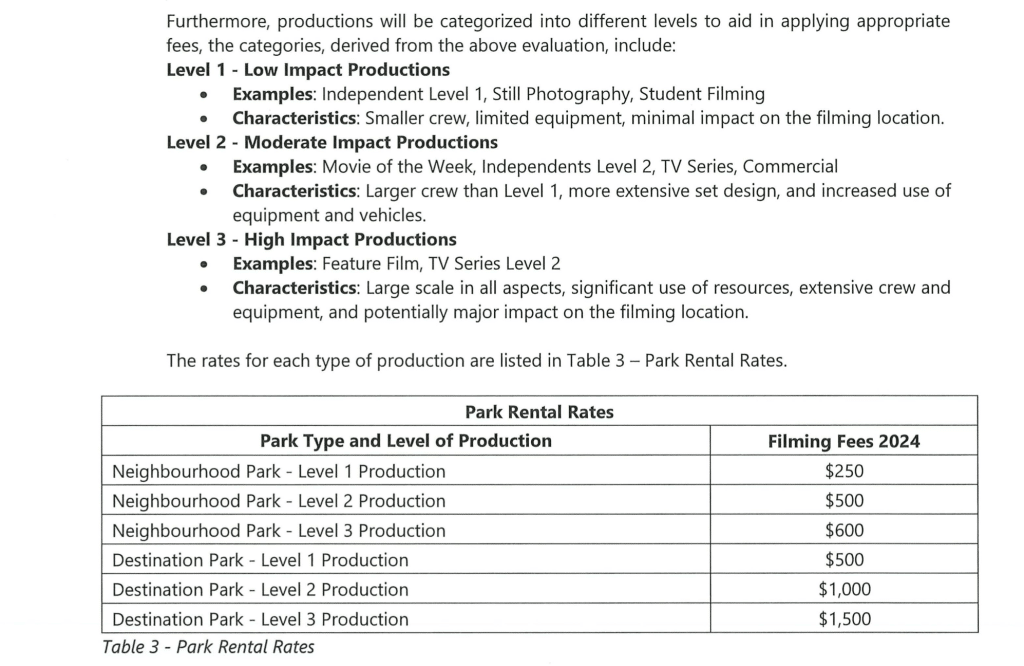
All film production companies will be broken down into three groups: Level 1, such as still photography or student projects, Level 2, including Movies of the Week or commercial filming, and Level 3, which encompasses feature film production.
Each production company will be charged between $250 and $600 — depending on their classification — to rent a neighbourhood park, or between $500 and $1,500 for a destination park.
A new flat fee of $50 was also created for non-profit or student-led organizations, which drew some criticism from Coun. Korleen Carreras, who wondered how that price was being implemented in other cities.
“It’s very expensive to be a student,” Carreras stated. “I have two kids in school so I know how difficult it is to come up with even $50.”
As the city sketched out updates for the film policy, Westover stated, they looked at film production rules in six other cities: Abbotsford, Burnaby, Coquitlam, Langley and Township of Langley, Mission, and Pitt Meadows.
While some municipalities didn’t have a policy on student fees, city staff stated the number was a “reasonable” target and one that would be covered by certain film schools or post-secondary institutions.
After brief discussion on the tier structure and noise exemption fee, council unanimously approved the motion.
Council will vote on the bylaw at an upcoming meeting.
Author